
It helps to know who delivers the water. Kitsap PUD operates the Suquamish water system for the village and much of the surrounding area, plus the Miller Bay Estates system. Some outlying parcels toward Miller Bay and north of the village are on private wells. At about 40 to 50 minutes from Port Orchard up Highway 3 and over on Highway 305 toward Agate Pass from Port Orchard, Suquamish is a regular line on our schedule, not a special trip.
Why water treatment & filtration systems is a little different in Suquamish
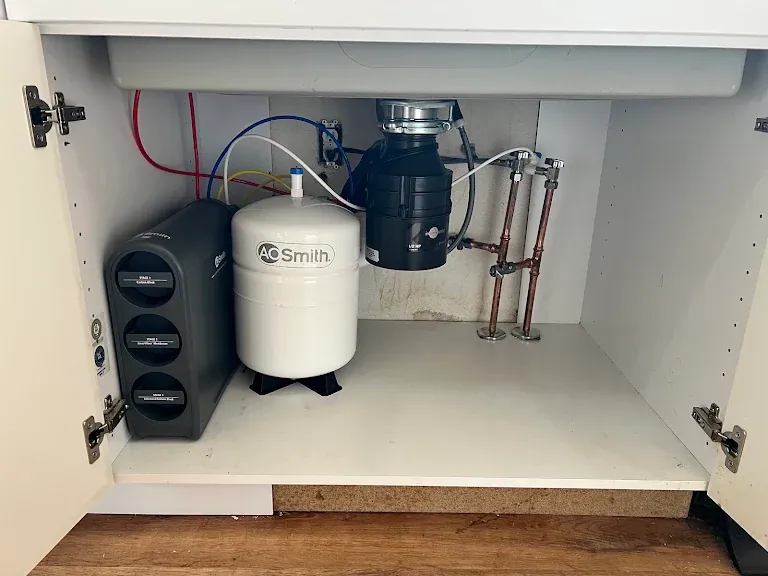
For Suquamish homeowners who want the last step for drinking water, we pair the whole-house system with an under-sink reverse osmosis unit at the kitchen. The whole-house filter protects the RO membrane, and the RO handles nitrates, arsenic and dissolved solids that point-of-entry systems are not built for.
What happens past the house is not the same across Suquamish. Kitsap County Sewer Utility operates a sewer system and treatment plant serving the Suquamish village core and the waterfront. The Suquamish Tribe also operates utilities for its own facilities. Outside the sewered core, the larger lots and the Miller Bay side are on septic.
Local conditions that affect water treatment & filtration systems in Suquamish
Here is a Suquamish detail that changes how we approach the job: Septic effluent pumps on the Miller Bay and outlying lots
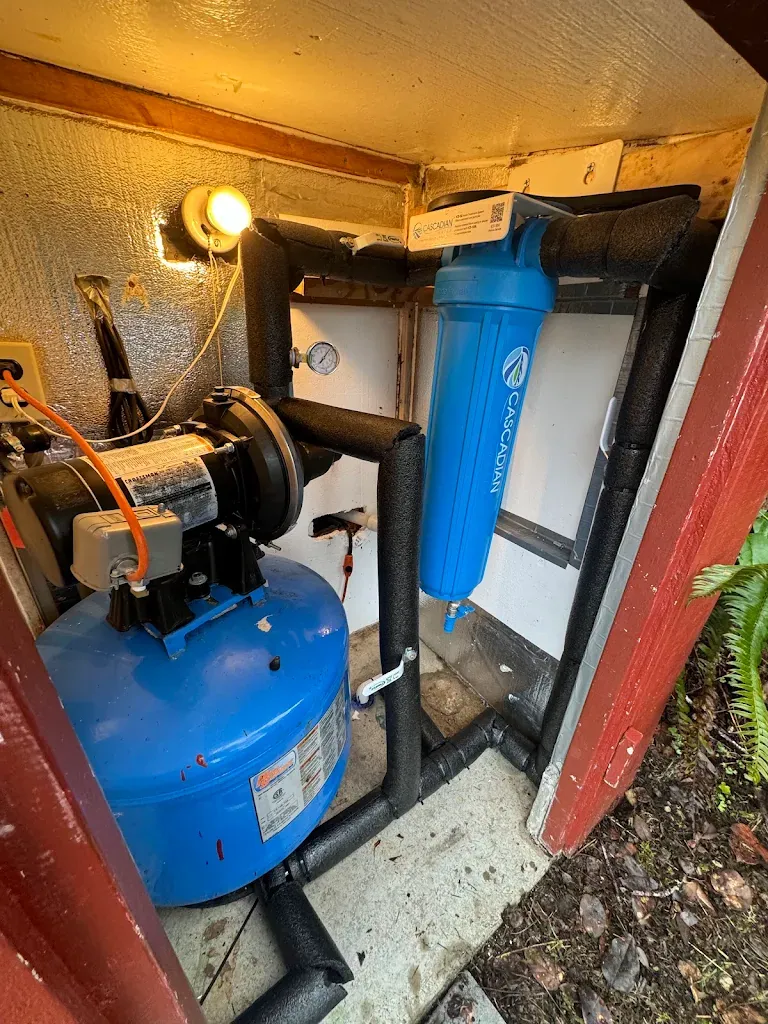
Pump houses and well sheds around Suquamish get cold enough in a hard freeze to split a filter housing, and we replaced several after the December 2022 and January 2024 cold snaps. When we install in an unheated space we insulate every line and talk about a heat source for the building.
The pattern we see most in Suquamish is this: Water heaters past their lifespan in 1970s and 80s homes
Older Suquamish homes on city water often have their own galvanized service line shedding rust into otherwise clean water. A sediment filter helps, but the real fix is replacing the line, and we tell you that rather than selling a filter to treat a problem the pipe is causing.
Signs Suquamish homeowners call us for water treatment & filtration systems
Worth a call
- Rotten-egg smell from the cold tap, or from the hot tap only
- Sand or grit in aerators, showerheads and the toilet tank
- Water tastes or smells like chlorine, especially in summer
- White scale on fixtures, shower glass and the inside of the kettle
- A tankless water heater that needs descaling every year
How we handle water treatment & filtration systems in Suquamish
Here is how it runs when we come to Suquamish for water treatment & filtration systems: test the raw water, size to the house, not the catalog, flat price with the options explained, install with bypass, drain and insulation, then start up, flush and set the schedule. Nothing is started until you have approved a flat price.
Read the full step-by-step for water treatment & filtration systems →
Suquamish neighborhoods and areas we serve
Whether you are near Suquamish Museum and Chief Seattle's grave at the Suquamish Memorial Cemetery or further out toward Division Avenue or Suquamish Way and Augusta Avenue, Suquamish addresses get the same arrival window and the same flat price.
Water Treatment & Filtration Systems questions from Suquamish
Can you install a filter in my Suquamish pump house?
Yes, and we do it often. The system goes after the pressure tank with a bypass and isolation valves, a drain for any backwashing tank, and insulated lines so it survives a freeze.
What does iron filtration cost for a Suquamish home?
A whole-house iron system is typically a four-figure project depending on the iron level and the flow the house needs. A sediment or carbon cartridge system is considerably less. You get a flat price after the test, before any work.
Will a filter fix the rotten-egg smell in my Suquamish water?
If the smell is in the cold water, yes, with an oxidizing or aeration system. If it is only in the hot water, the fix is usually the water heater's anode rod and no filter is needed. We check which before quoting.
Do you service filtration systems you did not install in Suquamish?
Yes. We change cartridges, replace media, repair control heads and, when a system was oversized or wrongly chosen, resize or replace it. We will tell you plainly if what you have is the wrong tool for your water.
How often do cartridges need to be changed?
Sediment cartridges every one to three months on a gritty well, less often on city water. Carbon cartridges every six to twelve months. Backwashing tanks need media replaced every several years. We give you a schedule based on your water and can handle the changes for you.
From Port Orchard it is an easy run to Suquamish, and we keep the trucks stocked so a repair rarely waits on a parts run. Water heaters, valves, pumps and fittings for the common jobs ride with us.