
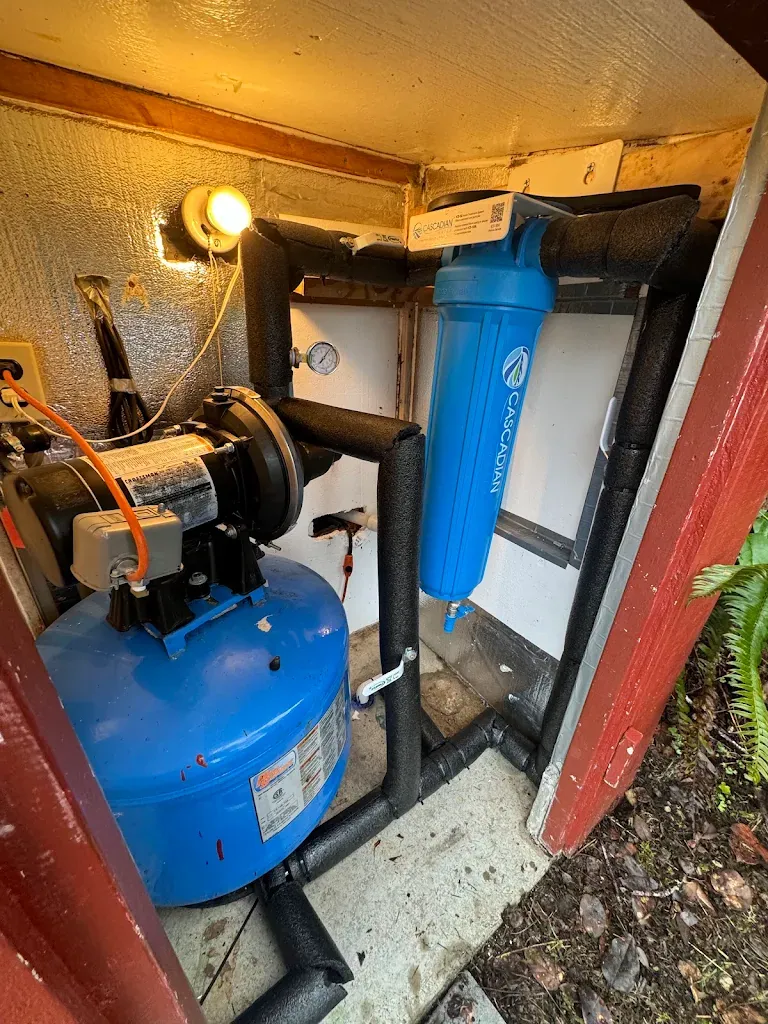
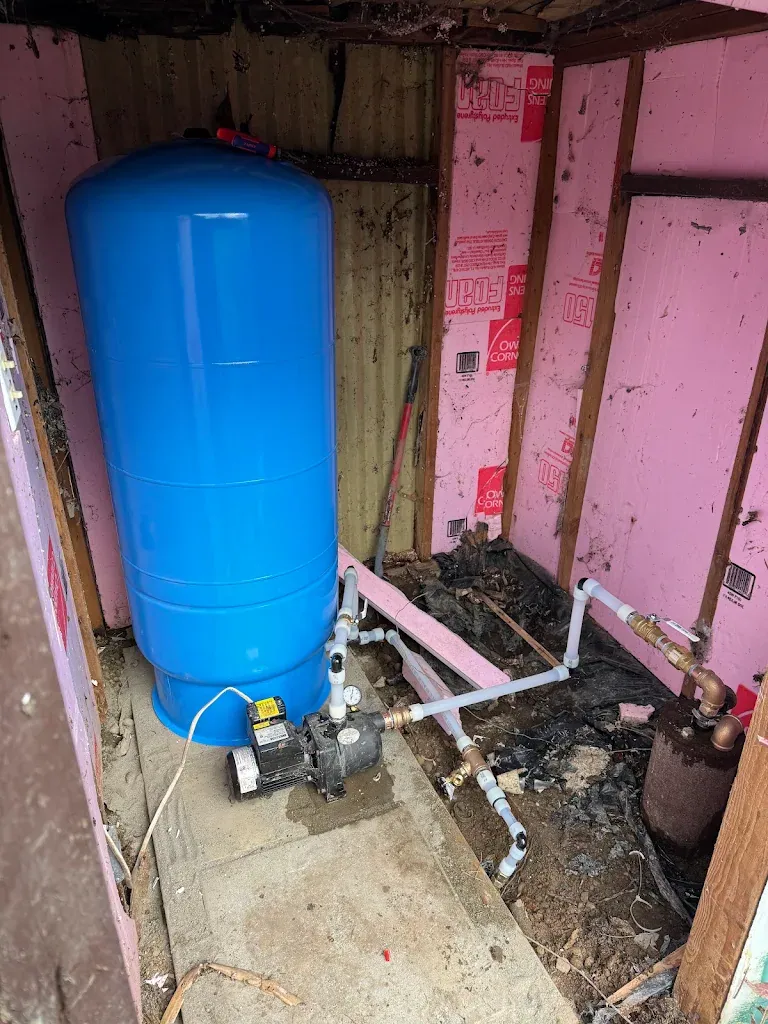
Washington Plumbing & Drain installs whole-house filtration at the point of entry across Kitsap, Pierce and Mason counties. We start with a water test, not a sales pitch, and we install Cascadian and Halo systems sized to what the test shows: sediment filters, iron and manganese filters, sulfur treatment, carbon for chlorine and taste, and scale control where a tankless heater or a glass shower door is suffering. The photos on this page show a Cascadian filter plumbed into a pump house alongside a new pressure tank, which is a typical well installation.
A good filter is invisible. The water tastes like water, the fixtures stay clean, the water heater lasts longer, and you change a cartridge or let a system backwash on schedule. A bad filter, or the wrong one, chokes your pressure and solves nothing. The difference is in the testing and the sizing, which is what this page explains.
What is actually in the water around here
Private wells in Kitsap and Mason County draw from aquifers in glacial sand and gravel, and the water picks up whatever the glacier left: dissolved iron and manganese, which stain fixtures orange and black and give water a metallic taste; hydrogen sulfide from decaying organic matter in the aquifer, which is the rotten-egg smell; sand and silt from shallow or older wells; and in places a low pH that slowly eats copper pipe. Hardness, the calcium and magnesium that scale a water heater, is moderate here but real, especially in deeper wells.
Municipal water from Kitsap PUD, West Sound Utility District, the City of Port Orchard, Silverdale Water District, the City of Bremerton and Tacoma Public Utilities is tested and treated, and in most homes it needs nothing. What people do notice is chlorine or chloramine taste and smell, which varies by season and by how far the house is from the treatment point, and sediment stirred up by main breaks and hydrant flushing. Older homes also pick up rust from their own galvanized service lines, which no utility can help with.
The only way to know is to test. We take a sample from the raw water ahead of any existing treatment and check iron, manganese, hardness, pH, and sulfur on the spot, and we send to a certified lab for anything a well owner should know about, such as bacteria, nitrates or arsenic, which does turn up in some Kitsap and Pierce County wells. We do not recommend equipment until the numbers are in hand.
Matching the filter to the problem
Sediment comes first, always. A spin-down or cartridge sediment filter ahead of everything else protects the rest of the system and the house from sand, silt and rust. On a well that pulls a lot of grit, a flushable spin-down filter you can clear in seconds beats a cartridge you replace every month. On city water a pleated cartridge sized to the house, changed a couple of times a year, does the job.
Iron and manganese need an oxidizing filter, a backwashing tank with media that converts dissolved metal into a solid it can trap, then flushes to drain on a schedule. These are the systems that end orange toilets and black streaks in the dishwasher, and they are sized to the iron level and the flow rate of the house. Sulfur is handled the same way, often with a different media or with aeration ahead of the tank. A water softener does not remove iron well and is the wrong tool when iron is the main complaint.
Chlorine, chloramine and taste on city water come out with a whole-house carbon filter, either a large cartridge or a backwashing carbon tank for a bigger house. Scale on a tankless heater or shower glass is addressed with a salt-free scale inhibitor or, for truly hard well water, a conventional softener. We will tell you plainly whether your hardness level justifies a softener, because many homes here are sold one they did not need.
- Sediment: spin-down or cartridge filter at the entry, ahead of everything
- Iron and manganese: backwashing oxidizing filter sized to the test and the house
- Sulfur smell: aeration or oxidizing media, sometimes with a new water heater anode
- Chlorine and taste: whole-house carbon cartridge or tank
- Scale: salt-free inhibitor for moderate hardness, softener for high hardness
- Low pH: neutralizer tank to protect copper pipe and fixtures
Installing a system that does not kill your pressure
Every filter is a restriction, and a system that is too small for the house turns a good shower into a weak one. We size the filter housings and the tanks to the peak flow the house actually uses, which is more than most online calculators assume for a family with two bathrooms and a laundry room. Large-port housings and full-flow valves cost a little more and are worth every dollar.
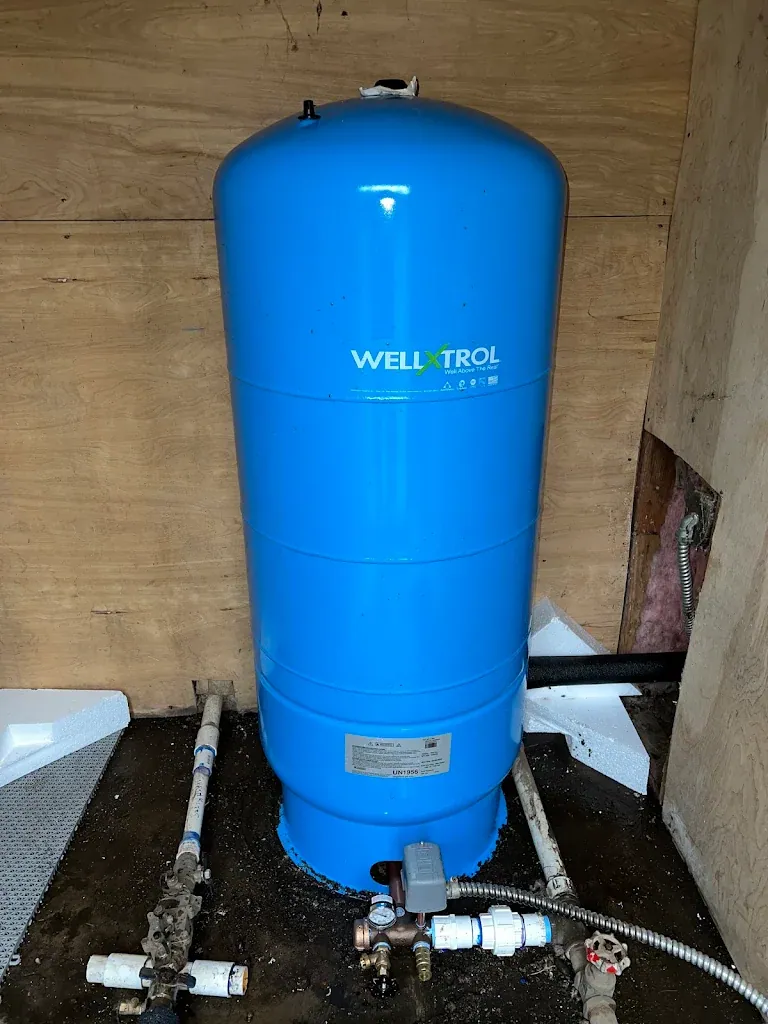
The system is installed at the point of entry, after the pressure tank on a well or after the main shutoff and PRV on city water, and before the water heater so the whole house, hot and cold, is treated. Backwashing tanks need a drain, which in a pump house or garage may mean running a line to a floor drain, a utility sink or outside, and they need a power outlet for the control head. We plumb everything with a bypass loop and isolation valves so the system can be serviced or taken offline without shutting the house down, as in the photos of our pump house installations.
Freeze protection matters out here. Pump houses in Mason County and detached well sheds in North Kitsap get cold enough to crack a filter housing, and we have replaced plenty that split in December 2022 and January 2024. Every line gets insulated, and we talk about heat tape or a small heater for the space when the installation is outside the house.
Drinking water, the water heater, and the rest of the house
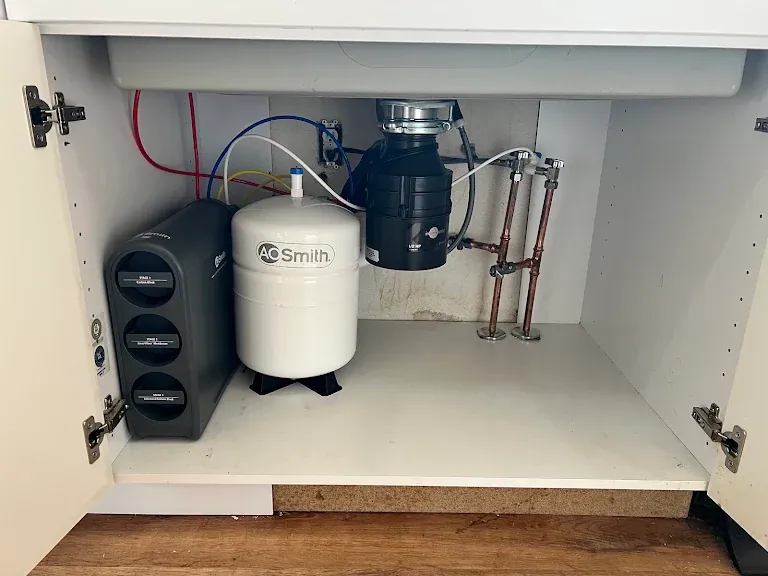
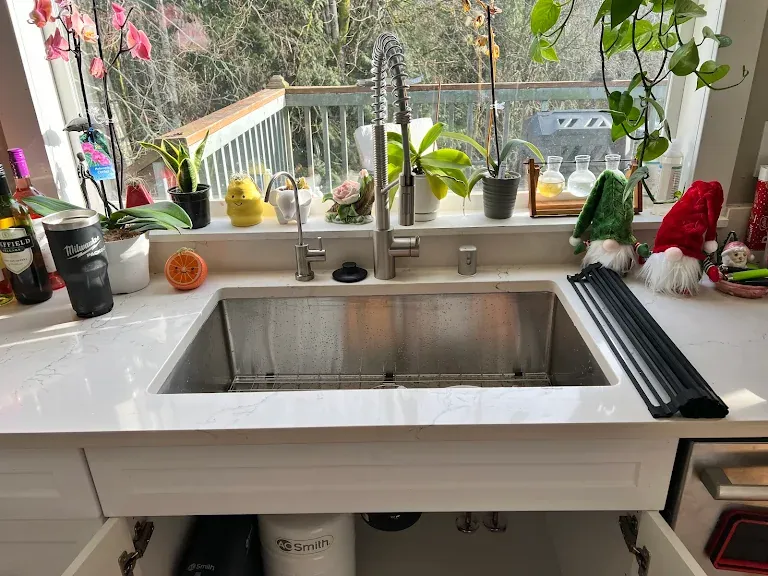
Whole-house filtration takes care of what you see, smell and bathe in. For what you drink, an under-sink reverse osmosis system at the kitchen takes the last step, removing dissolved solids, nitrates, arsenic and anything else a lab report flags. We install A. O. Smith RO systems with their own faucet, and the photos on this page show one set up under a kitchen sink alongside a new disposal. The two systems work together: the whole-house filter protects the RO membrane, and the RO handles what the whole-house filter is not designed for.
The water heater is the other beneficiary. Sediment and iron that never reach the tank never settle in it, and water that is no longer scaling the heat exchanger means a tankless unit goes longer between descalings. For homes with sulfur odor in the hot water only, a filter may not even be needed; switching the heater's anode rod often solves it, and we check that first because it is a much smaller job.
Service, cartridges and the long run
Cartridge systems need new cartridges on a schedule that depends on your water, usually every few months for sediment and every six to twelve for carbon. Backwashing systems need media replaced every several years and a check of the control head and the drain. We set up each customer with a plain schedule, stock the common cartridges, and can come out for the changes if you would rather not crawl into the pump house in January.
We also service and repair systems other companies installed, including the ones that were oversold. A fair number of our filtration calls start with a homeowner who was talked into a softener for iron water or a tiny cartridge for a four-bathroom house, and the fix is often removing or resizing something rather than adding more. Our recommendation comes from the test, and we will show you the numbers that led to it.
Signs you need water treatment & filtration systems
Call if you notice
- Orange or brown stains in toilets, tubs and the dishwasher
- Rotten-egg smell from the cold tap, or from the hot tap only
- Sand or grit in aerators, showerheads and the toilet tank
- Water tastes or smells like chlorine, especially in summer
- White scale on fixtures, shower glass and the inside of the kettle
- A tankless water heater that needs descaling every year
- Blue-green stains on fixtures, a sign of low pH eating copper
- A lab report showing nitrates, arsenic or bacteria in a well
- Cloudy water after rain or after the utility flushes hydrants
- An existing filter that drops the shower to a trickle
How a water treatment & filtration systems call goes
Test the raw water
On-site testing for iron, manganese, hardness, pH and sulfur from the water ahead of any existing treatment, and a lab sample for bacteria, nitrates or arsenic on wells when warranted.
Size to the house, not the catalog
Peak flow is estimated from the fixtures and the household, and every housing, tank and valve is chosen so the system treats the water without choking the pressure.
Flat price with the options explained
A written price for the system the test calls for, with any optional pieces, such as RO at the kitchen or a scale inhibitor for the tankless heater, shown separately so you choose.
Install with bypass, drain and insulation
The system goes in at the point of entry with a bypass loop and isolation valves, a drain for any backwashing tank, power for the control head, and insulated lines in any unheated space.
Start up, flush and set the schedule
Media is conditioned and flushed, backwash timing is set to your water, cartridges are dated, and you get a plain maintenance schedule and a stock of the first replacements.
Questions we get about water treatment & filtration systems
Do I need a water softener or a filter?
It depends on what the test shows. Iron, manganese, sulfur and sediment need filters, not a softener. High hardness that scales a water heater and leaves spots on glass may justify a softener or a salt-free scale inhibitor. Many homes in this area are sold softeners for problems a softener does not solve, which is why we test first.
My water smells like rotten eggs. What fixes that?
If the smell is in both hot and cold water, it is hydrogen sulfide in the well and needs an oxidizing filter or aeration. If it is only in the hot water, it is bacteria reacting with the water heater's anode rod, and changing the anode usually fixes it with no filter at all. We check which you have before quoting.
Will a whole-house filter lower my water pressure?
A properly sized one should not noticeably. The pressure complaints we see come from undersized cartridge housings and clogged cartridges that were never changed. We size to the home's peak flow, use large-port housings, and install a bypass so a clogged filter never leaves you without water.
How often do cartridges need to be changed?
Sediment cartridges every one to three months on a gritty well, less often on city water. Carbon cartridges every six to twelve months. Backwashing tanks need media replaced every several years. We give you a schedule based on your water and can handle the changes for you.
Does a whole-house filter make the water safe to drink?
It makes it clean, clear and pleasant. For dissolved contaminants like nitrates, arsenic or anything a lab flags, an under-sink reverse osmosis system at the kitchen is the right tool, and we install those alongside whole-house systems. Bacteria require disinfection, which is a separate conversation we have when a lab test shows it.