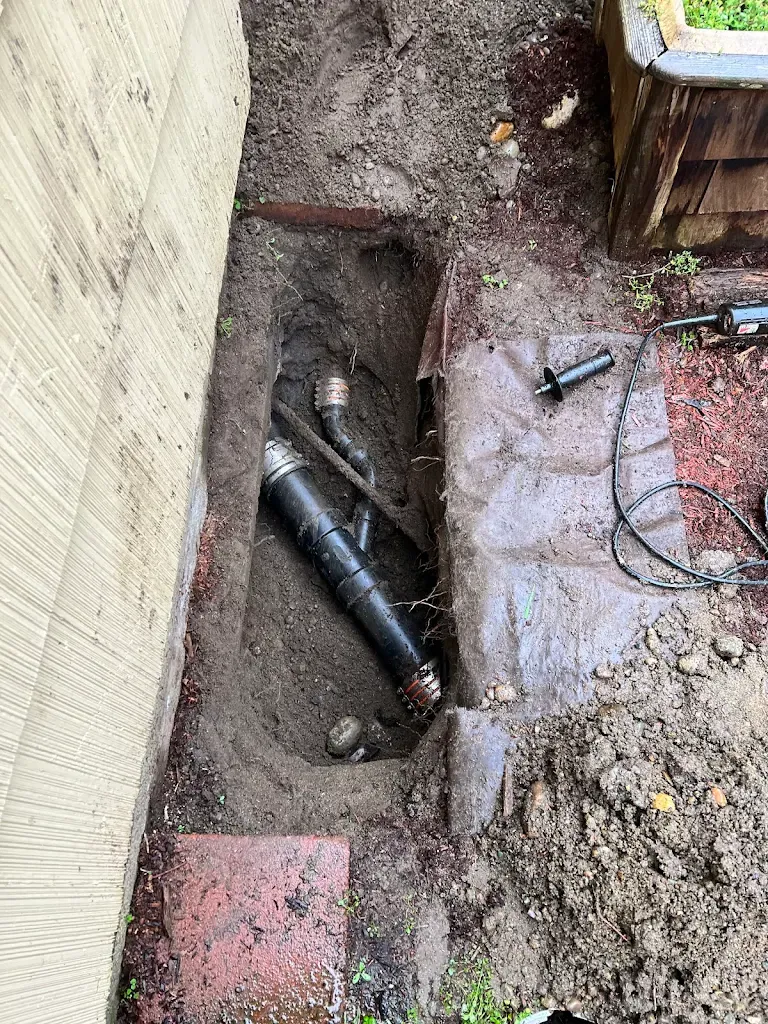
Washington Plumbing & Drain repairs and replaces side sewers from Port Orchard and Bremerton out to Gig Harbor, University Place, Belfair and Shelton. We dig, we replace the failed pipe with new ABS or PVC on proper bedding, we add cleanouts where there were none, and we test the line before the trench is closed. Our excavation work is done in-house with our own crew.
A sewer line is not a place for shortcuts. A repair that is bedded in the same loose fill that let the original pipe sag will sag again. We treat the dirt as seriously as the pipe.
How sewer laterals fail around Puget Sound
The soils here are a big part of the story. Glacial till is dense and holds water, clay swells and shrinks with the seasons, and loose fill around a foundation settles for years after a house is built. A pipe laid across those soils on a bad bed will develop a belly, a low spot that holds water, catches paper and sludge, and eventually becomes the clog that never fully clears.
Then there are the materials. Cast iron rusts from the inside until the bottom of the pipe is paper thin. Clay and concrete pipe were laid in short sections with joints that roots pry open. Orangeburg, used in some neighborhoods into the early 1970s, is a tar-soaked fiber pipe that goes oval under load and then folds flat. ABS and PVC laterals from the 1980s onward are generally sound unless a joint was glued badly or something crushed the pipe.
Trees finish the job. Fir, cedar, maple, alder and the ornamental cherries and birches in older neighborhoods all send roots toward the one reliable water source in a dry August yard, which is a leaking sewer joint. Once the roots are in, every cable cleaning opens the joint a little more.
Spot repair or full replacement
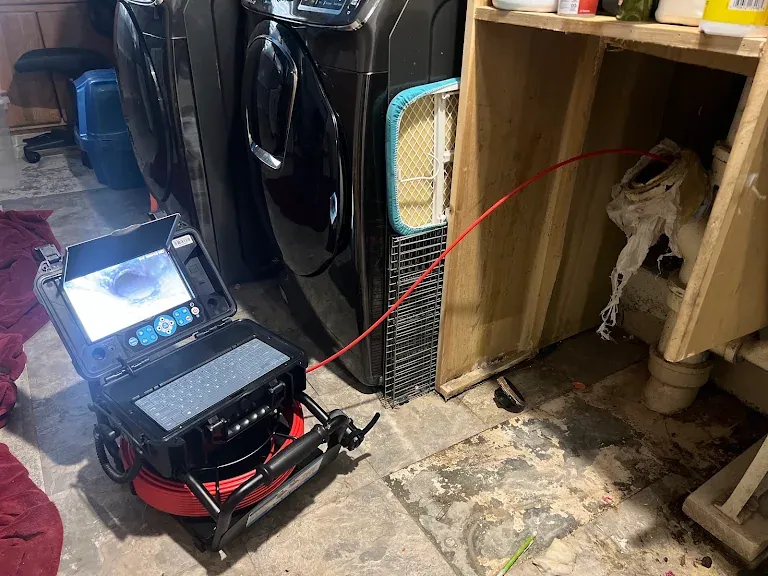
A camera inspection and a surface locate tell us whether the problem is a single joint or a whole line. If one section has a belly or a break and the rest of the pipe is sound, we excavate at that spot, cut out the bad section, and splice in new pipe with the correct transition couplings. That is a day's work on most properties and a fraction of the cost of replacing the whole lateral.
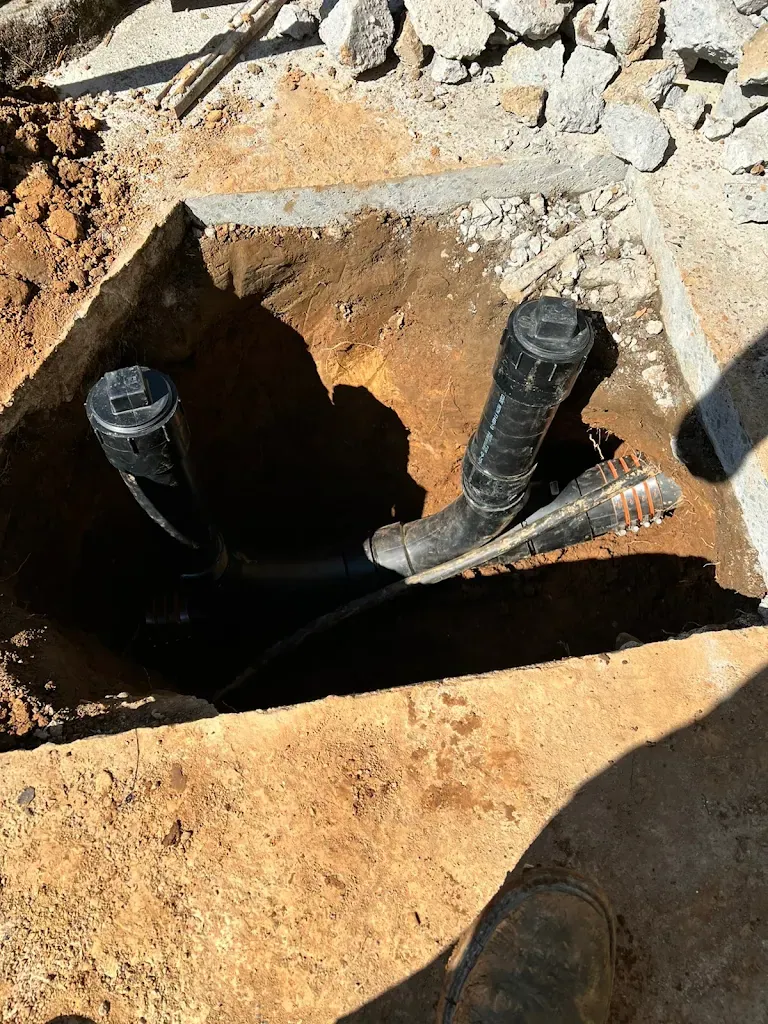
A full replacement is the right answer when the camera shows failures at several points, when the pipe is Orangeburg or badly scaled cast iron, or when a belly runs for most of the line's length. In that case we trench from the house to the connection at the street main or the septic tank, lay new pipe at a continuous slope, and set a two-way cleanout near the foundation.
We do not do trenchless pipe bursting or lining, and we will say so. For some properties those methods are a good fit and we will point you toward them. For many, especially lines with bellies that a liner cannot fix, open excavation is the better repair, and it is the one we are set up to do well.
What a proper excavation repair involves
Before a shovel goes in, utilities are located. Gas, water, power and communications all share the strip of ground between a house and the street, and in Kitsap and Pierce County that often includes a private water service line running right alongside the sewer. We dig carefully around what the locates show and hand-dig close to anything that matters.
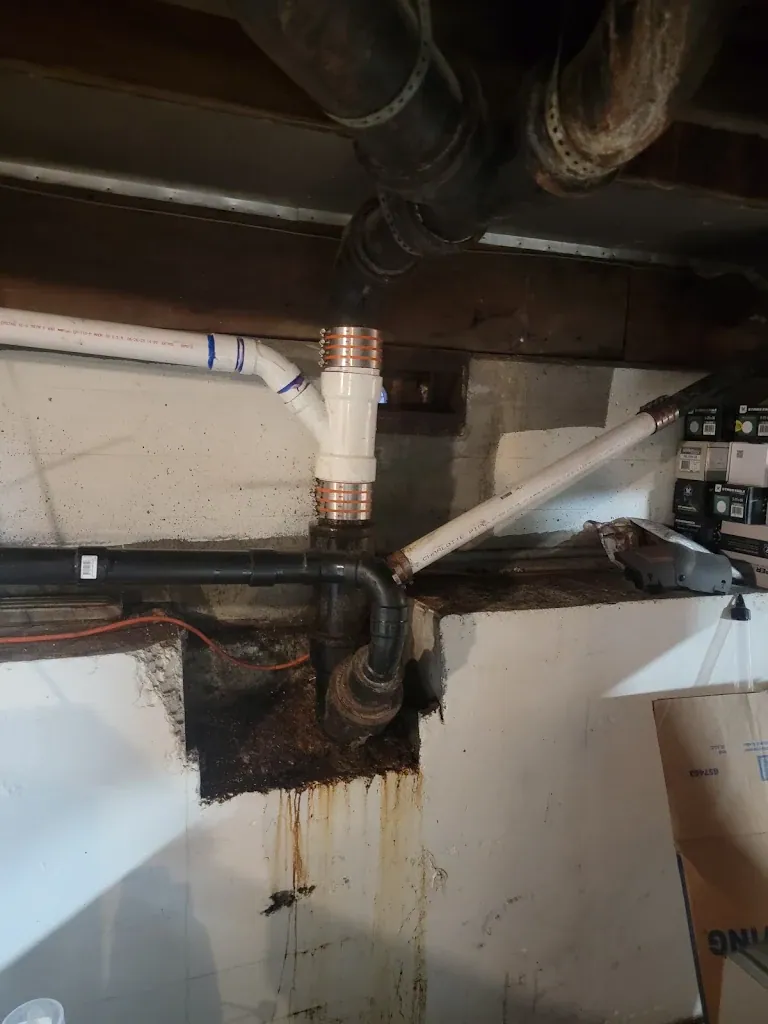
The trench is dug to the pipe, the failed section is removed, and the bottom of the trench is shaped and bedded with crushed rock so the new pipe has uniform support along its full length. New ABS or PVC is laid at the correct slope, connected with shielded couplings or solvent-welded fittings depending on the materials being joined, and a cleanout riser is brought to grade. The line is tested before backfill.
Backfill goes in in lifts and is compacted, because loose fill settling around a new pipe is how the next belly forms. Concrete and asphalt that had to be cut are patched. The yard will show it for a season, but the pipe underneath will not.
- Utility locates before digging
- Crushed rock bedding under and around the new pipe
- Continuous slope with no low spots
- Two-way cleanout at the foundation
- Test before backfill, compacted backfill in lifts
City sewer, county sewer and septic connections
Who owns which part of the sewer matters. On Kitsap County Sewer, City of Bremerton, City of Port Orchard, Pierce County and Tacoma systems, the homeowner is generally responsible for the side sewer from the house to the main, including the portion under the public right of way in many cases. The utility handles the main itself. We verify the local rules for your address before quoting so you know whose problem the repair is and what permits apply.
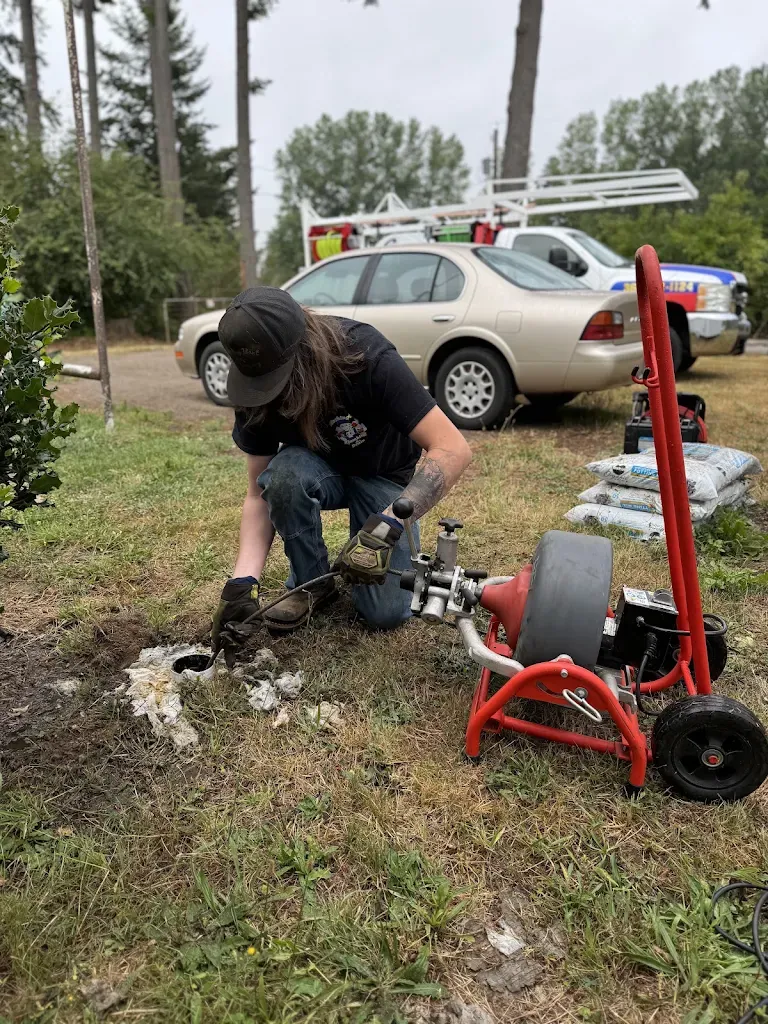
On a septic home the lateral runs to the tank inlet, and the repair stops at the tank. If the inlet baffle has failed or the tank itself is damaged, a septic contractor handles that part and we will tell you plainly where the line between our work and theirs falls. We coordinate with them when a job needs both.
Permits, inspection and your records
Side sewer work requires a permit and inspection with the local jurisdiction, and the repair must be inspected open before it is backfilled. We pull the permit, schedule the inspector, and keep the trench open until the work is signed off. You get the permit record, the inspection sign-off and the before-and-after camera footage.
That paperwork matters when you sell. A buyer's sewer scope will find a new section of pipe, and a permitted, inspected repair with footage is an asset. An unpermitted one is a question mark.
Pricing you approve before the dig
A sewer repair is priced after the camera and locate, because the footage and depth tell us how much digging and pipe the job needs. A spot repair at modest depth is a four-figure project; a full lateral replacement under a driveway or deep in till is more. Either way the number is on your phone before anyone digs, and it does not change unless you change the scope.
If you are deciding between repair now and a cleaning schedule for a while longer, we will lay out both options without a sales pitch. A belly that only causes trouble once a year may be worth living with for a season. A collapsing Orangeburg line is not.
Signs you need sewer line repair & replacement
Call if you notice
- The main line clogs again within weeks of being cleared
- The camera showed roots, a belly, a separated joint or a crushed section
- Sewage smell in the yard, the crawlspace or near the foundation
- A soggy or unusually green strip of lawn between the house and the street
- A dip or sinkhole appearing in the yard or driveway over the sewer path
- Multiple drains back up at once and a cable will not pass a certain footage
- The house drains through Orangeburg, clay or badly scaled cast iron
- A sewer scope during a home purchase found a defect the seller is willing to address
How a sewer line repair & replacement call goes
Camera and locate
The line is cleared if needed, scoped end to end, and each defect is located and marked on the surface with its depth. You watch the footage with the plumber.
Written estimate, your decision
You get a flat-rate estimate for a spot repair or a full replacement, with the reasoning explained. Approve it on your phone when you are ready; there is no pressure to decide that day.
Permit and utility locates
We pull the side sewer permit with your city or county and have all underground utilities marked before excavation.
Excavate and replace
The trench is opened at the marked location, the failed pipe is removed, the trench is bedded with crushed rock, and new ABS or PVC is laid at continuous slope with a cleanout at the foundation.
Inspect, test and backfill
The inspector signs off on the open trench, the line is tested, and backfill goes in compacted in lifts. Concrete or asphalt is patched.
Footage and records
You receive the permit record, the inspection sign-off, and camera footage of the finished line.
Questions we get about sewer line repair & replacement
How do you know where to dig?
The camera head carries a beacon. After scoping the line we walk the surface with a receiver, find the exact spot above each defect, and mark it with the depth. The trench goes there, not the whole length of the yard.
Do you do trenchless sewer repair?
No. We do open excavation repairs and replacements, and we are honest about that. Lining and pipe bursting have their place, and we will tell you if your line is a good candidate so you can get that quote too. Many lines around here have bellies, which a liner cannot correct.
Who is responsible for the sewer line between my house and the street?
In most Kitsap and Pierce County jurisdictions the homeowner owns the side sewer all the way to the main, including under the sidewalk and street. We confirm the rule for your address before quoting.
Will a sewer repair wreck my yard?
A spot repair is a trench a few feet long. A full replacement is a trench the length of the lateral, backfilled and compacted. Lawn recovers in a season. We cut and patch concrete or asphalt where the line runs under it.
Can you repair a sewer line on a septic system?
Yes, from the house to the tank inlet. If the inlet baffle or the tank is the problem, a septic contractor handles that, and we coordinate with them when both are needed.
Do I need a permit for sewer line repair in Washington?
Yes. Side sewer work is permitted and inspected by the local jurisdiction, and the trench has to be inspected open. We pull the permit and schedule the inspection as part of the job.
How long does a sewer replacement take?
A spot repair is usually a single day. A full lateral replacement is typically two to three days depending on length, depth, soil and what is on the surface. We give you a realistic schedule with the estimate.
Could the problem be the city main instead of my pipe?
Occasionally. If the camera runs clean all the way to the main and the backup persists, the main may be surcharged, and that is the utility's responsibility. We tell you and help you report it rather than selling you a repair you do not need.