
Short answer
Reverse osmosis pushes water through a membrane so fine that dissolved minerals, metals and most contaminants cannot follow. It removes the large majority of total dissolved solids, including arsenic, nitrate, lead, fluoride, sodium and most PFAS, and it does so at one tap for drinking and cooking. It is not a whole-house solution, it needs sediment and carbon pre-filters to protect the membrane, it sends a stream of reject water to the drain, and it does not by itself make bacterially unsafe water safe. On Kitsap well water, it pairs with iron or sulfur treatment upstream; on city water, it mostly improves taste.
In this guide
Key takeaways
- RO strips dissolved solids: minerals, salts, metals like arsenic and lead, nitrate, and most PFAS compounds.
- It does not reliably handle bacteria or dissolved gases, and it is not a substitute for UV on a well that tests positive.
- A standard system has a sediment pre-filter, a carbon pre-filter, the membrane, a storage tank, and a carbon post-filter.
- Expect a few gallons to the drain for every gallon produced; modern systems waste less but none waste nothing.
- RO water is low in minerals and slightly acidic; some people add a remineralizing stage for taste.
- Filters need changing on schedule or the membrane fouls; a neglected RO system quietly stops doing its job.
The membrane and why it works
Osmosis is water moving across a membrane from the dilute side to the concentrated side. Reverse osmosis uses pressure to push it the other way, from the dirty side to the clean side, and the membrane's pores are so small that water molecules squeeze through while dissolved ions and larger molecules are left behind. The rejected material stays in a concentrate stream that goes to the drain.
That is the key fact. RO is not a sieve that eventually fills up; it is a continuous separation that always has two outputs, permeate for your glass and concentrate for the sewer. The membrane is a tightly wound sheet in a cartridge about the size of a paper towel roll, and under household pressure it makes clean water slowly, a few gallons an hour, which is why there is a storage tank.
What reverse osmosis removes
A properly working membrane rejects the large majority of total dissolved solids. That covers the things that worry people most in well water and in some city water.
- Arsenic, which occurs naturally in some Puget Sound aquifers and has no taste or color
- Nitrate, which shows up near older septic systems and agricultural land
- Lead and copper dissolved from old pipe and solder
- Sodium, including the sodium a softener adds
- Fluoride, for those who want it out
- Most PFAS compounds, which RO handles better than carbon alone
- Hardness minerals, sulfate and chloride that affect taste
- Dissolved iron and manganese at low levels, though the membrane fouls fast if levels are high
What it does not do
RO is a drinking water system, not a whole-house one. It treats the tap it is connected to and, if you run a line, the refrigerator. Showers, laundry and the water heater still get whatever comes from the well or the utility. If the problem is iron stains or rotten-egg odor through the house, RO does not touch it.
The membrane will physically block bacteria, but RO systems are not certified as disinfection and the clean side can be recontaminated at the storage tank, the faucet, or during filter changes. A well that tests positive for bacteria needs the well addressed and a UV unit on the house supply; the RO can sit behind that. The same goes for dissolved gases like hydrogen sulfide, which pass through a membrane and come out the faucet smelling the same.
High levels of dissolved iron, manganese, hardness or chlorine shorten membrane life sharply. That is why the pre-filters exist and why, on a Kitsap or Mason County well with the metals we usually find, whole-house iron treatment belongs ahead of the RO rather than being replaced by it.
The parts under the sink
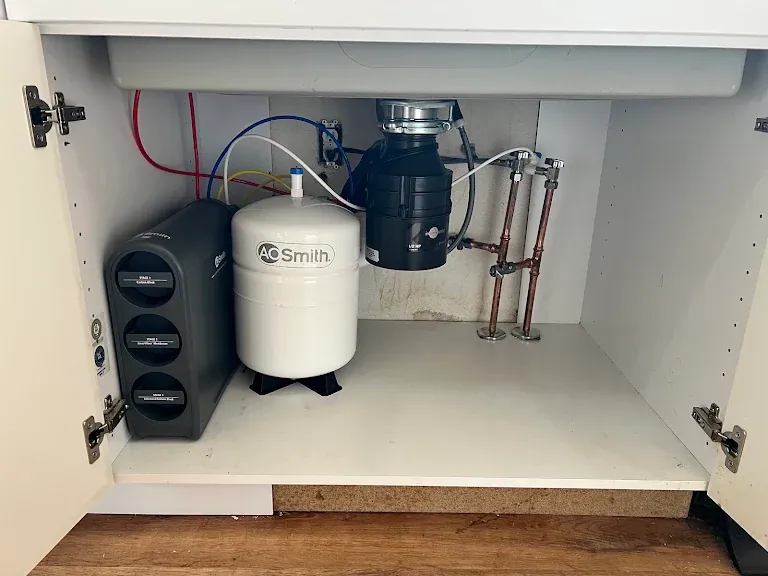
Open the cabinet and you will see a row of filter housings, a small pressure tank, and a thin line to a separate faucet at the sink. Water enters a sediment filter first to catch particles, then a carbon filter that removes chlorine, which would otherwise destroy the membrane. From there it goes through the membrane; the permeate fills the tank, and the concentrate goes to a drain saddle on the sink's drain line with an air gap to keep sewer water from backing in.
When you open the RO faucet, water leaves the tank through a final carbon polishing filter that removes any taste picked up from the tank. Some systems add a remineralizing cartridge to put a little calcium and magnesium back for taste and to raise the pH, since pure RO water is slightly acidic and tastes flat to some people. Others add a UV stage or a booster pump for low-pressure homes.
The systems we install, A. O. Smith among them, are standard-format units with readily available replacement cartridges. We avoid proprietary cartridges that only one vendor sells, because the next owner of the house should be able to maintain the system without hunting.
Reject water, pressure and the drain
Every gallon of RO water comes with concentrate to the drain. Older systems sent three or four gallons down for every one produced; newer membranes and permeate pumps bring that down considerably. On a septic property that reject water goes to the tank, which is harmless, but it is more water than people expect, so we point it out. On a well, it is water the pump had to lift.
RO needs pressure to work. Below about 40 psi, production slows and the reject ratio worsens, and some homes on hills or with long lines fall into that range. A small permeate pump or booster on the system solves it, and we check incoming pressure before installing. Homes with a pressure reducing valve set low sometimes just need the valve adjusted.
RO on city water versus well water
On Bremerton, Port Orchard, Silverdale, Poulsbo or Tacoma water, the supply is already treated and soft. RO at the sink mostly improves taste, removes the chlorine the carbon stage catches, and gives peace of mind on lead from old household plumbing or on anything the utility report mentions. It is a quality-of-life install, and plenty of our customers love it for coffee and cooking.
On a well, RO can be a health install. If a test shows arsenic or nitrate, RO at the drinking tap is the standard, affordable fix, far cheaper than treating the whole house for a contaminant you only need out of the water you swallow. The membrane needs protection from the iron and manganese typical of local wells, so the usual layout is a whole-house sediment and iron filter first, then the RO under the sink. We size the pre-treatment from the lab results rather than guessing.
Maintenance and what neglect looks like
Pre-filters typically change every six to twelve months, the post-filter yearly, and the membrane every two to five years depending on the water. A simple TDS meter, which costs little, tells you whether the membrane is still rejecting: measure tap water and RO water, and if the RO reading has crept up toward the tap reading, the membrane is done.
A neglected system fails quietly. The storage tank's bladder loses charge and the faucet dribbles; the pre-filters clog and production drops; the membrane fouls and TDS rises; and the water still looks clear. We label the housings with dates at install and show you the change procedure, which takes ten minutes with the valve closed. If the tank sits unused for weeks, as in a vacation cabin, drain and refill it before drinking.
Frequently asked
Does reverse osmosis remove bacteria?
The membrane blocks bacteria physically, but RO systems are not disinfection devices and the clean side can be recontaminated. If a well tests positive, the fix is addressing the well and installing UV on the house supply; RO can sit behind that for drinking water.
Is RO water bad for you because it removes minerals?
RO water is low in minerals, and that is the point of it. Dietary minerals come overwhelmingly from food, not water. If you prefer the taste of mineralized water, a remineralizing cartridge adds a little calcium and magnesium back.
Can I hook the refrigerator up to the RO system?
Yes. A tee off the RO line to the fridge's ice maker and water dispenser is a common add-on. It slows refill a little because the fridge draws from the same small tank; a larger tank fixes that.
How much water does RO waste?
It varies by system and pressure. Older units sent several gallons to the drain per gallon made; current designs with better membranes or a permeate pump do markedly better. It is never zero, and on a septic system the reject goes to the tank.
Will RO remove the rotten-egg smell from my well water?
Not reliably. Hydrogen sulfide is a dissolved gas and passes through the membrane. Sulfur odor is a whole-house problem solved with oxidation or carbon treatment at the point of entry.
Does my well water need RO?
Only a lab test can say. If arsenic, nitrate or lead show up, RO at the drinking tap is the right tool. If the test is clean and the complaint is taste, it is a preference. We will tell you which based on the numbers.
About the author. Gregory Lowe is the owner and lead plumber at Washington Plumbing & Drain, a veteran-owned company in Port Orchard serving Kitsap, Pierce and Mason counties. The guidance here comes from daily work in local homes, not from a content farm. Call (360) 812-1124 with questions.