Short answer
Tree roots get into sewer lines through leaking joints and cracks, following the moisture and nutrients that seep out, and in the Pacific Northwest's tree-dense, wet-winter, dry-summer climate they do it faster than almost anywhere. Roots do not break into a sound pipe; they exploit one that is already leaking. Cutting and jetting keep the line open, but only repairing the entry point ends the cycle. Which approach makes sense depends on pipe material, how often the line clogs, and what the camera shows.
In this guide
Key takeaways
- Roots enter through existing leaks at joints and cracks. A root-filled line is a leaking line.
- Clay, concrete and Orangeburg laterals with many joints are the most vulnerable; glued PVC and ABS are much less so.
- Firs, cedars, maples, willows, poplars and cottonwoods are the trees we find in pipes most around Kitsap and Pierce County.
- Root cutting restores flow for a season; hydro jetting with a root nozzle clears more thoroughly; neither stops regrowth.
- Chemical root killers slow regrowth but do not remove roots and can harm plants and septic systems.
- The permanent fix is to repair or replace the section the roots are entering, with new cleanouts so you can inspect it later.
Why the Northwest grows roots into pipes so well
Look at any older lot in Port Orchard, Bremerton or Gig Harbor and you will see the problem standing in the yard. Second-growth Douglas fir and western red cedar, planted or volunteered over decades, bigleaf maples with root systems as wide as the canopy, and the fast-growing willows and poplars people put in during the 1970s for quick shade. All of them are water-seeking, and all of them were planted near or over sewer laterals that have been leaking a little for years.
Then the climate does the rest. From October to April the soil is saturated and roots have water everywhere. From July to September it is dry, and the only consistent moisture in the yard is the vapor and seepage coming off a sewer joint. Roots grow toward that like a hand reaching for a glass. By the time the fall rains return, the root mass inside the pipe has had a whole summer to thicken.
This is why so many root-related backups hit in the first weeks of the rainy season. The line was already narrowed by summer growth, and the first big flush of storm infiltration brings silt and debris that the roots catch.
How roots actually get inside
A root does not punch through intact pipe. It finds a gap: a bell-and-spigot joint in clay tile where the mortar has washed out, a rubber gasket that has aged, a crack in concrete pipe eaten by sewer gas, a seam in Orangeburg that has begun to delaminate, or a glued PVC joint that pulled apart when the ground shifted. Moisture and nutrients weep out of that gap into the surrounding soil, and a root hair as fine as thread follows the trail back in.
Once inside, the root has everything it wants: constant water, constant fertilizer, and no competition. It thickens and branches. The gap it came through gets forced wider. Eventually the root mass fills the pipe and the joint that let it in has been broken open to the point that soil and groundwater enter freely.
The practical lesson is that root intrusion is a symptom of a pipe defect. You can treat the symptom for years, and plenty of people do, but every treatment leaves the defect in place and a little larger.
Which pipes are most at risk
Vitrified clay tile, common in laterals around here from the 1920s through the 1960s, comes in short sections with a joint every few feet, and each joint is a potential entry. Concrete pipe from the same era has the same joint problem plus a tendency to lose its interior to corrosion. Orangeburg, used in the 1950s and 60s, has seams along its length and softens as it ages, so roots enter almost anywhere.
Cast iron under the house is less inviting to roots because its joints are leaded or gasketed and it is usually in a crawlspace rather than in soil. The trouble is where cast iron meets the yard pipe, typically a few feet outside the foundation, since that transition joint is a frequent leak point.
ABS and PVC, standard since the 1970s, have glued joints that roots rarely penetrate. When we find roots in plastic pipe it is almost always at a joint that was never glued properly, a section that separated due to settling, or a spot where someone drove a stake or a fence post through the pipe.
Signs that roots are your problem
Root intrusion has a signature. These are the things that make us bring the root cutter rather than the small cable.
- The main line clogs on a schedule, often late summer through early winter, and runs fine after cleaning
- Multiple drains gurgle or back up together while individual fixtures drain normally when the rest of the house is idle
- The last cabling pulled back fine white root hairs or stringy fibers on the cutter
- There are mature trees, hedges or large shrubs within twenty feet of the sewer path
- The house predates 1975 and has never had its lateral replaced
- A patch of lawn over the sewer stays greener in August than the rest of the yard
Cutting, jetting and what each one buys you
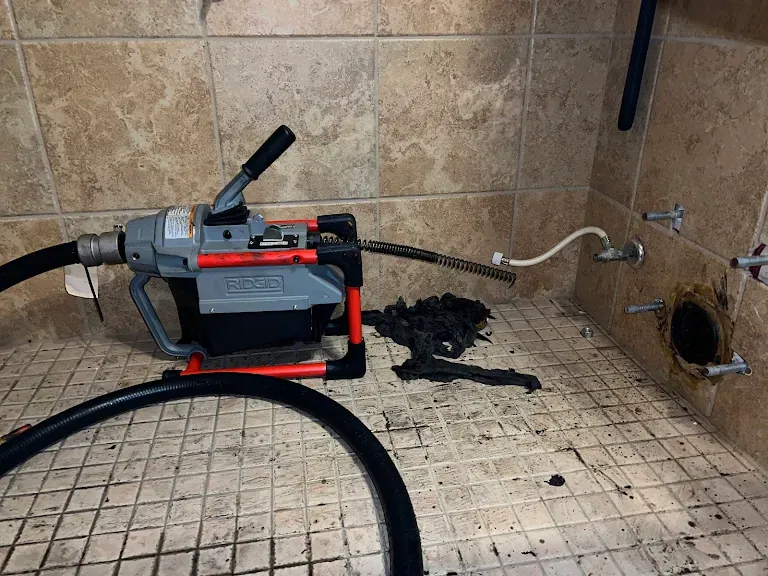
A cable machine with a root-cutting blade sized to the pipe is the standard first response. It chops the root mass into pieces that wash downstream and restores flow quickly. Because the cutter follows the pipe's center, it leaves root stubs along the wall, and those stubs regrow. For many homes that means a cutting every year or so, which is an acceptable maintenance cost for a line that is otherwise sound.
Hydro jetting with a root nozzle goes further. The rotating high-pressure jets shear roots at the pipe wall and flush the fragments, leaving less behind to regrow. Jetting also cleans the silt and sludge that roots collect, which cabling just stirs. On a clay or concrete line in decent structural shape, jetting typically buys a longer interval than cutting, and we often pair it with a camera pass to document the entry points.
Neither method closes the gap the roots came through. That is the honest limit of drain cleaning, and anyone who tells you a yearly service solves root intrusion is describing a subscription, not a solution.
Root-killing chemicals, with caveats
Copper sulfate and foaming herbicide products exist to slow regrowth after a cutting. The foaming types coat the pipe wall and kill root tissue inside the pipe without harming the tree. Used as directed after a mechanical cleaning, they can stretch the interval between services.
They have real drawbacks. Copper sulfate is toxic to the bacteria a septic tank depends on, so we do not recommend it for septic homes in Mason County or rural Kitsap. Any of these products flushed to a municipal system ends up in Puget Sound eventually, and several local utilities ask customers to avoid them. They also do nothing for the structural defect, and they can mask a worsening problem until the line fails outright. Think of them as a supplement to a plan, not the plan.
Repairing the entry point for good
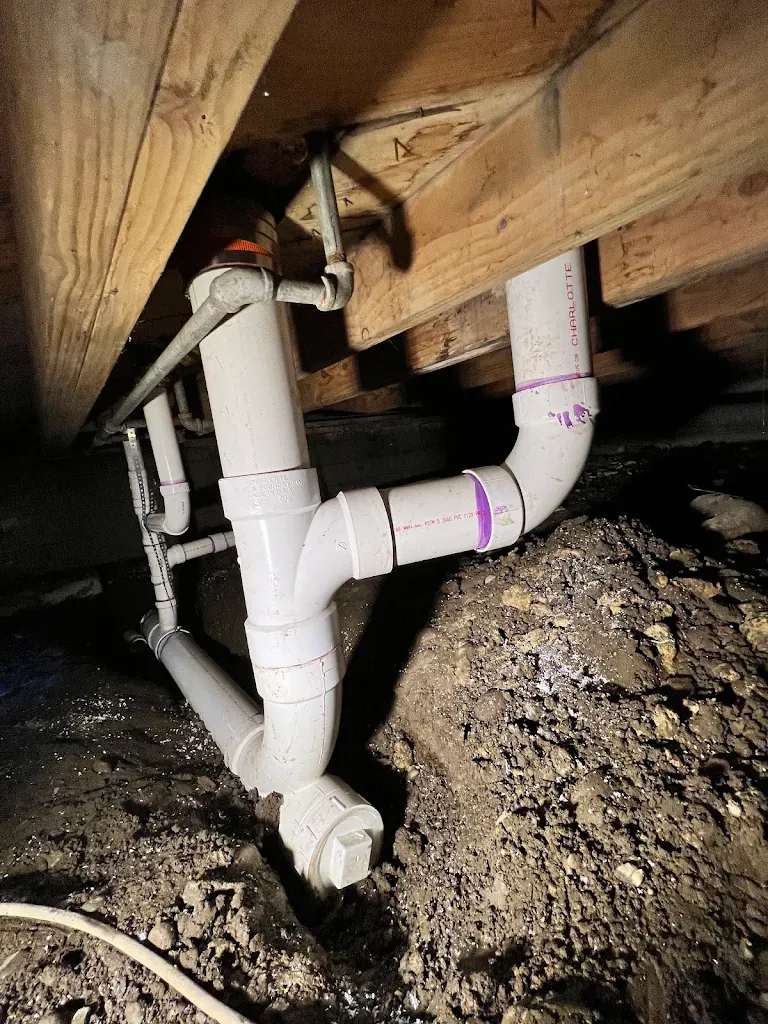
When the camera shows roots entering at one or two specific joints in an otherwise serviceable line, a spot repair is the efficient answer. We locate the joint from the surface, excavate to it, cut out the damaged section, and install new PVC with proper transition couplings to the old pipe. A new cleanout goes in at the same time so the line can be camera-checked and cleaned without pulling a toilet.
When the line is clay or Orangeburg with roots at every joint, a spot repair just moves the problem to the next joint. Full replacement of the lateral from the house to the main or the septic tank is the right call, and on most residential lots it is a one- to two-day excavation. We do this work with our own crew and equipment. We do not do trenchless pipe bursting, and we will tell you plainly if your situation is one where a trenchless contractor should be in the conversation.
Either way, the result is a line with glued joints that roots cannot find a way into, a cleanout for the future, and an end to the yearly root call. For a lot of our customers that is the first time in decades their sewer has not been on the calendar.
Keeping roots out after the repair
A new lateral is only as safe as what gets planted over it. Keep large trees and fast-rooting species well away from the sewer path, and when you do plant near it, choose shallow-rooted ornamentals. Mark the line on your property records so the next owner does not put a maple over it.
If you keep an older clay line and manage it with cleaning instead of replacement, put the service on a calendar before the fall rains rather than waiting for a backup. Ask for a camera look every few years to watch the entry joints. When they start widening, you will know the repair conversation is coming, and you can plan for it on your own schedule instead of during a holiday weekend.
Frequently asked
Will cutting roots damage my tree?
No. The roots inside your sewer are a tiny fraction of the tree's root system. Cutting them back has no meaningful effect on the tree's health. Repairing the pipe so roots cannot get in also does the tree no harm.
How often will roots come back after cabling?
It varies with the tree, the pipe, and the season, but on an older clay line with mature trees nearby, yearly is typical and twice a year is not unusual. Jetting with a root nozzle usually extends that. Only a repair of the entry point ends it.
Can roots get into PVC pipe?
Rarely, and only through a defect: an unglued or separated joint, a crack, or a puncture. If we find roots in a plastic line, we look for the specific failure point because it is usually a single spot and a quick repair.
Is it safe to use a root-killer product on a septic system?
We advise against copper sulfate on septic systems because it harms the bacteria the tank needs. Some foaming products claim septic compatibility; read the label carefully and ask your septic service company before using any of them.
Who pays if the roots are from the neighbor's tree or a street tree?
In practice, the property owner whose line it is handles the repair. Root intrusion is treated as a condition of the pipe, not a fault of the tree's owner. If the roots are entering the utility's main rather than your lateral, that part is the utility's responsibility.
Can you show me the roots before I decide on a repair?
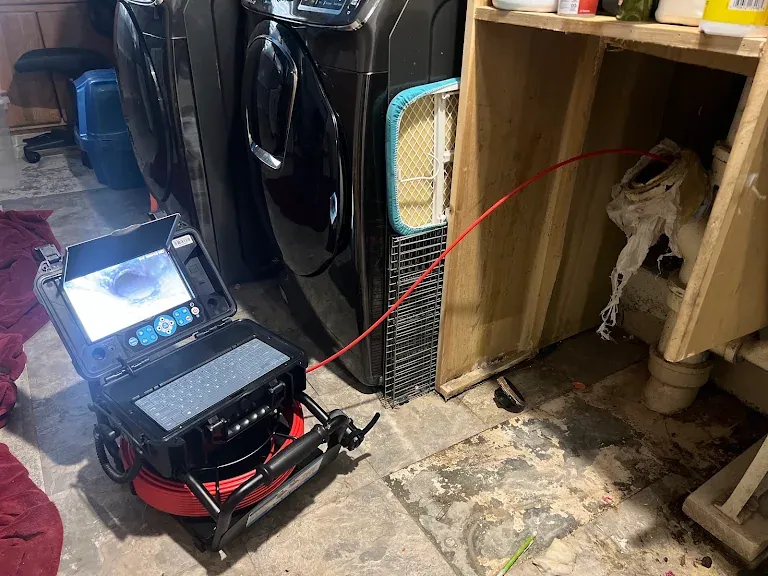
Yes. We run the camera after clearing the line and you watch the monitor with us. The video and a surface locate of the entry points come with the estimate, so you are deciding based on what is actually in the pipe.
About the author. Gregory Lowe is the owner and lead plumber at Washington Plumbing & Drain, a veteran-owned company in Port Orchard serving Kitsap, Pierce and Mason counties. The guidance here comes from daily work in local homes, not from a content farm. Call (360) 812-1124 with questions.