
What it usually looks like
- The pump clicks on and off rapidly while you run a shower or fill the tub
- Water pressure surges and drops at the faucet in a pulsing rhythm
- The pressure gauge needle swings fast between the cut-in and cut-out numbers
- The pressure tank feels heavy and sounds solid when you knock on it, top to bottom
- The pressure switch contacts are pitted, buzzing or arcing
- Breakers trip or the well house smells hot after a long shower
Likely causes, most common first
Waterlogged pressure tank
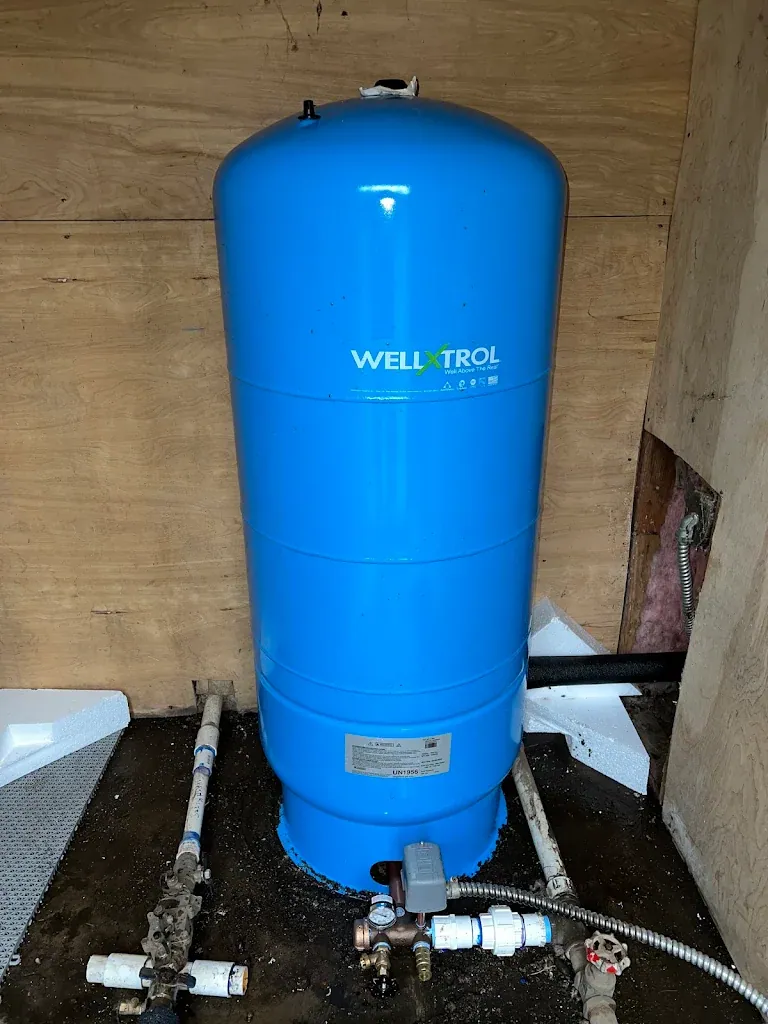
A bladder tank holds a charge of air above a rubber diaphragm. That air compresses as the pump fills the tank and pushes water out between cycles. When the bladder tears or the air leaks out through the Schrader valve, the tank fills with water, there is no cushion, and the pump cycles on every drop of pressure. This is the cause nine times out of ten.
Wrong pre-charge in the tank
Even an intact bladder needs the right air pressure, normally two psi below the pump's cut-in setting. A tank that was never charged correctly, or that was charged while full of water, delivers a fraction of its rated drawdown and the pump cycles far more than it should.
Pressure switch set too narrow or failing
The switch should have about a 20 psi spread between on and off, such as 40/60. Corroded contacts, a clogged nipple below the switch, or a spring that drifted will shorten the spread and cause rapid cycling. Iron and manganese in Mason County well water love to pack that small nipple with sludge.
A leak between the pump and the tank
A failed check valve, a leaking pitless adapter or a cracked drop pipe lets pressure bleed back down the well. The pump then cycles on and off even when no water is being used in the house, which is a different pattern from cycling only during use. A check valve in the well house is a plumbing repair; a leak down the casing is pump company work.
An undersized tank for the pump
A high-output pump paired with a tiny tank fills it in seconds. Each cycle is short by design, and the pump sees far more starts per day than it was built for. Upsizing the tank solves it.
Low-yield well or clogged screen
If the well cannot keep up, some pumps are protected by a low-pressure cutoff or a pump-saver that shuts them down and restarts them, which can look like cycling. This is more common in the shallow wells near Hood Canal and on the Key Peninsula during late summer, and it is a well and pump question rather than a tank question.
Safe things to check yourself first
- Watch the pressure gauge while someone runs a faucet. Note the cut-in and cut-out pressures and how fast the needle moves between them.
- Knock on the pressure tank from top to bottom. A healthy tank sounds hollow on top and solid near the bottom. Solid all the way up means it is full of water.
- Turn the pump breaker off, open a faucet until pressure drops to zero, then check the air valve on top of the tank with a tire gauge. Water coming out of the air valve means a ruptured bladder.
- Look for water leaking around the tank, the switch, the fittings and the well cap.
- Note whether the pump also cycles when nobody is using water. If so, suspect a leak or a check valve, not just the tank.
- Check the age of the tank. A sticker or stamp gives the date, and tanks older than ten years are often at the end.
Stop and call if
- Water sprays out of the tank's air valve, which confirms a ruptured bladder
- The pressure switch is arcing, buzzing, scorched or smells hot
- The pump breaker trips repeatedly
- Pressure never reaches the cut-out and the pump runs continuously
- The tank is rusting through, bulging or leaking at the seam
How we diagnose and fix it
- Check the pre-charge with the system drained and compare it to the switch settings, then test the bladder for rupture.
- Replace waterlogged tanks with a correctly sized Well-X-Trol or Amtrol bladder tank, charged to match the switch, with a new tank tee, gauge and relief valve.
- Clean or replace the pressure switch and its nipple, and set the spread to the right range for your pump and household.
- Isolate the system to test for a failing check valve when the pump cycles with no demand, and replace the check valve in the well house when that is where the leak is.
- Upsize the tank or add a second one when the pump output is more than the existing tank can buffer.
- Tell you plainly when the tests point past the well house to the pump, the drop pipe or the pitless adapter, and refer you to a well pump company for that part of the job.
Around Kitsap, Pierce and Mason counties
Private wells supply a large share of homes in Mason County and the rural parts of Kitsap, from Seabeck and Hansville down through Olalla and across to Tahuya and Grapeview. The pressure tank usually lives in a pump house or a crawlspace, which means it is cold in winter and often ignored. Iron and manganese in that water pack the pressure switch nipple and corrode the tank from the inside, so tanks here rarely reach the lifespans the manufacturers advertise. When we replace one we also check the switch, gauge and relief valve, because they are all the same age and usually just as tired.
Questions people ask
Can I just add air to my pressure tank?
If the bladder is intact and the tank is simply low on charge, yes. Drain the tank first with the pump off, set the air to two psi below cut-in, and watch it over a week. If the charge drops again or water comes out of the air valve, the bladder is gone and the tank needs replacing.
How long does a well pressure tank last?
Ten to fifteen years is typical with good water. With iron-heavy water or a pump that has been short cycling for a while, five to eight years is common.
Will short cycling ruin the pump?
Yes, given time. Every start draws a surge of current and heats the motor windings. A pump that should last twenty years can be gone in a few if it cycles thousands of times a day. Fixing the tank is how you protect it.
What size pressure tank do I need?
It depends on pump flow rate and how many fixtures the house has. The rule of thumb is a drawdown of at least one gallon per gallon-per-minute of pump output, which for most homes means a tank in the 40 to 85 gallon total volume range. We size it on site rather than guessing.
What if the pump itself turns out to be the problem?
We do not pull or replace well pumps. If the tank, switch and check valve all test fine and the pump still cannot hold or build pressure, we tell you that is where the trouble is and refer you to a well pump company. We are glad to coordinate with them and finish the well house side once the pump is set.