
Short answer
A well pressure tank stores water against a cushion of compressed air so the pump runs in long, healthy cycles. When the air charge is lost, the tank waterlogs and the pump starts and stops every few seconds, which is short cycling, and it burns out pumps and switches. Low or surging pressure usually traces to the air charge, the pressure switch, or a clogged filter before it traces to the pump. Two quick checks with the pressure gauge and a tire gauge tell you which, and a tank that will not hold air needs replacing.
In this guide
Key takeaways
- Short cycling is the pump turning on and off rapidly while water runs. It almost always means a waterlogged tank.
- Check the air charge with a tire gauge on the tank's valve stem with the pump off and the system drained; it should read about 2 psi below the switch's cut-in.
- Water coming out of the air valve means the bladder has failed and the tank is done.
- A pressure switch with burned contacts or a plugged sensing tube causes erratic pressure and nuisance pump stops.
- Pressure that drops steadily during a shower is often a clogged sediment filter, not a pump problem.
- Repeated short cycling shortens pump life dramatically; fix the tank before the pump pays for it.
What the tank is doing when everything works
Open a faucet on a healthy well and watch the pressure gauge at the tank. It starts near 60 psi and falls slowly as water leaves the tank; the pump is not running yet. Around 40 psi the pressure switch clicks, the pump starts, pressure climbs back to 60, the switch clicks off, and the cycle begins again. With a tank sized right, that cycle takes a minute or more with a faucet running, and the pump rests between cycles.
The air charge inside the tank is what makes this possible. In a modern bladder or diaphragm tank, air is sealed in the top and pre-charged to a few psi below cut-in. As the pump pushes water in, the air compresses and stores energy. As water is drawn, the air expands and pushes water out. No air, no storage, and the pump has to run for every cup of water.
Short cycling: what it sounds like and why it matters
Stand near the tank with a faucet running and listen. If you hear the pressure switch clicking and the pump starting and stopping every few seconds, that is short cycling. The gauge needle will swing fast between cut-in and cut-out instead of drifting. Lights may flicker with each start if the pump is a large one.
Each start is the hardest moment in a pump motor's life, drawing several times its running current and heating the windings. A pump that should start a few thousand times a year is now starting that many times a month. Submersible pumps that should last two decades fail in five under those conditions, and pressure switch contacts pit and weld. This is why we treat short cycling as urgent even when water is still coming out of the tap.
The cause is nearly always a tank that has lost its air charge, either through a slow leak at the valve stem or through a ruptured bladder that let water into the air side. Occasionally a tank is simply too small for the pump, which shows up as a short cycle even with the correct charge.
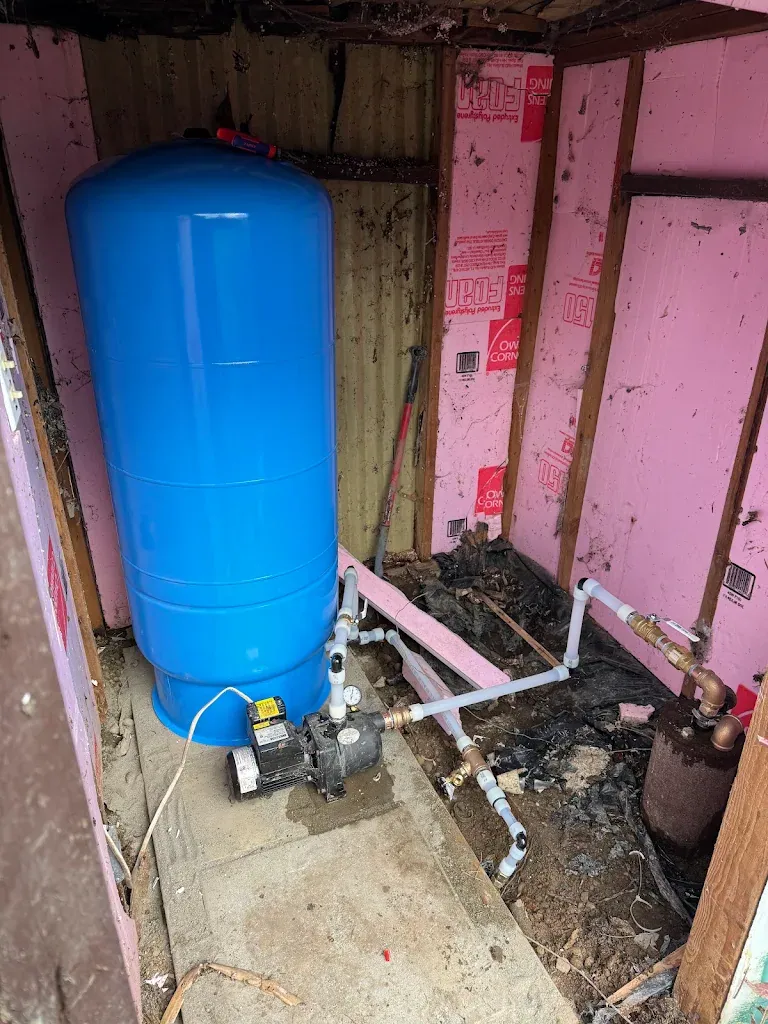
The two checks you can do yourself
Both take ten minutes and a tire gauge. Turn off the breaker to the pump first so the system does not refill while you work.
- Open a faucet and let the system drain until water stops and the gauge reads zero
- Find the air valve on the top of the tank, under a plastic cap, and press a tire gauge onto it
- Read the pressure. It should be about 2 psi below the switch's cut-in, so roughly 38 psi on a 40/60 system
- If the reading is far low, add air with a compressor or bicycle pump to the correct number and recheck after a day; a tank that keeps losing air has a leak
- If water sprays out of the air valve, the bladder has ruptured and the tank must be replaced
- Tap the tank from top to bottom: a healthy tank sounds hollow above the waterline and dull below; a tank that sounds dull all the way up is waterlogged
- Restore power and watch a full cycle on the gauge to confirm the pump now runs for a reasonable stretch
Low pressure that is not the tank
If the tank checks out and the pump runs in normal cycles but the shower is weak, the water is being held back somewhere between the tank and the fixture. The first suspect on most local wells is the sediment filter. Iron and sand load a cartridge fast, and a filter that is six months overdue can cut flow in half. Pull the cartridge and run the system without it for a minute; if pressure comes back, there is your answer.
The second suspect is the pressure switch setting. A switch set to 30/50 gives a noticeably softer shower than 40/60, and some houses on hills or with long lines benefit from the higher range if the pump can deliver it. Adjusting the switch is a small job but it must be matched with the tank's air charge, so we do both together.
After that come the less common causes: a check valve sticking partly closed, a pitless adapter o-ring leaking back into the well, galvanized house pipe closing up, or a pump that has worn its impellers and cannot reach cut-out anymore. The last one shows as a pump that runs and runs without the gauge climbing to 60. The check valve and the house pipe are ours to fix; a pitless leak or a worn pump is a job for a well pump company, and we will say so when the tests point there.
When the pressure switch is the culprit
The switch is a small box with a spring, a diaphragm, and a set of electrical contacts, mounted on a short nipple at the tank tee. Three things go wrong with it. The contacts burn from arcing, especially on systems that have been short cycling, and the pump stops starting reliably or chatters. The sensing nipple plugs with iron scale or sediment so the switch cannot feel the real pressure and responds late or not at all. Or the spring and diaphragm wear and the cut-in and cut-out drift.
A plugged nipple is the one that fools people. Pressure in the house falls to nothing, the pump never starts, and the switch looks fine. We pull the switch, find the nipple packed with rust, and replace both. On wells with iron, a stainless or brass nipple and a periodic look prevent the repeat.
Some symptoms mimic a bad switch but live elsewhere. A pump that runs continuously with the gauge stuck below cut-out is usually a pump, a leak, or a dry well, not a switch. A tripping pump breaker is a motor or wiring problem. We check the switch first because it is cheap and fast, then move down the list, and when the list runs past the well house to the pump itself we refer you to a pump company rather than guessing.
Replacing a pressure tank done right
Tanks fail in two ways: the bladder ruptures, or the steel shell rusts through at the bottom, which is common when a tank sits on a damp crawlspace floor in Kitsap for twenty years. Either way the replacement is more than swapping the tank. We size the new tank to the pump's flow so the pump gets a minimum run time of a minute or more per cycle. Bigger tanks mean fewer starts and longer pump life; the old tank was often undersized to begin with.
The tank tee gets rebuilt at the same time: new pressure switch, new gauge, a proper relief valve, a drain, and a full-port shutoff so the house can be isolated from the well. We set the air pre-charge to match the switch, strap or stand the tank off the floor, and run the system through several cycles before leaving. Well-X-Trol and Amtrol tanks are what we install most because they hold up.
If the home is on a hill or has long runs and the owner has lived with weak pressure for years, this is the moment to talk about a booster pump after the tank. Sometimes a correctly sized tank and a 40/60 switch solve it alone; sometimes the house wants more than the pump can give, and a constant-pressure controller on the pump itself is a conversation for the pump company.
Symptoms that mean call now
A pump that will not shut off, a breaker that trips repeatedly, water spraying from a tank or fitting, or no water at all after the checks above are problems that get worse with time, and they can leave a rural house without water for days. We stock common tanks, switches and gauges, and tank and switch calls are usually same-day or next-day in Kitsap and Mason County. If the diagnosis lands on the pump, we tell you right away so a well pump company can be lined up without losing a day.
If the well house or tank location has frozen, shut the pump breaker off before thawing so the pump does not run against a blockage. A split tank tee during a January freeze is one of the more common emergency calls we take in the rural parts of the county.
Frequently asked
What pressure should my well tank be charged to?
About 2 psi below the pressure switch cut-in, measured with the pump off and the system fully drained. On a common 40/60 switch, that is 38 psi. Check it with a tire gauge on the valve at the top of the tank.
Can I just add air to a waterlogged tank?
If the bladder is intact and the tank only lost charge through the valve, yes, and it may hold for years. If water comes out of the air valve, or the tank loses air again within days, the bladder has failed and the tank needs replacing.
How long does a pressure tank last?
Commonly 10 to 20 years. Tanks in damp crawlspaces rust from the bottom; tanks on systems that short cycle fatigue the bladder faster. A tank that is older than the pump deserves a look before anyone calls a pump company.
Why does my pressure surge up and down in the shower?
That rhythmic surge is the pump cycling rapidly, which points to a waterlogged tank. Less often it is a pressure switch with a narrow or drifting range. Either way the air charge check is the first step.
The pump runs but pressure never reaches 60. What is wrong?
Possibilities, roughly in order: a leak between the pump and the tank (including a leaking pitless or a cracked line under the yard), a worn pump that cannot build full pressure, a well that is low on water, or a switch set higher than the pump can reach. We check for leaks on the house side and read the gauge under load to sort them, and if the answer is the pump or the pitless, that goes to a well pump company.
Is a bigger pressure tank better?
Within reason, yes. A larger drawdown means the pump runs longer and starts less often, which extends its life. The limit is space and cost; most homes do well with a tank sized to give at least a minute of pump run time per cycle.
About the author. Gregory Lowe is the owner and lead plumber at Washington Plumbing & Drain, a veteran-owned company in Port Orchard serving Kitsap, Pierce and Mason counties. The guidance here comes from daily work in local homes, not from a content farm. Call (360) 812-1124 with questions.