
Short answer
A smart water shutoff valve is worth it for homes that sit empty for stretches, homes with finished space below plumbing, homes on wells or long service lines, and anyone whose insurer offers a discount for one. It monitors flow and pressure on the main line, learns the house's normal use, and closes the valve on its own when it sees a burst pipe or a slow leak that runs too long. It will not stop a pipe from freezing or detect a leak that happens before the valve, but for the most common and most expensive water damage, a supply line failure while nobody is home, it turns a flooded house into a wet floor.
In this guide
Key takeaways
- The device installs on the main line after the shutoff and before the first branch, and monitors every drop that enters the house.
- It catches two things: a sudden high-flow burst, and a small continuous flow that never stops, like a cracked supply line or a running toilet.
- A daily pressure test can detect tiny leaks that would not show up as flow at all.
- It does not detect leaks before the valve (the service line, the well) or drain and sewer problems, and it does not prevent freezing.
- Second homes on Hood Canal, rentals, homes with Navy owners deployed for months, and houses with living space below bathrooms get the most from it.
- Many insurers give a premium discount for a professionally installed automatic shutoff. Ask yours.
What the device actually does
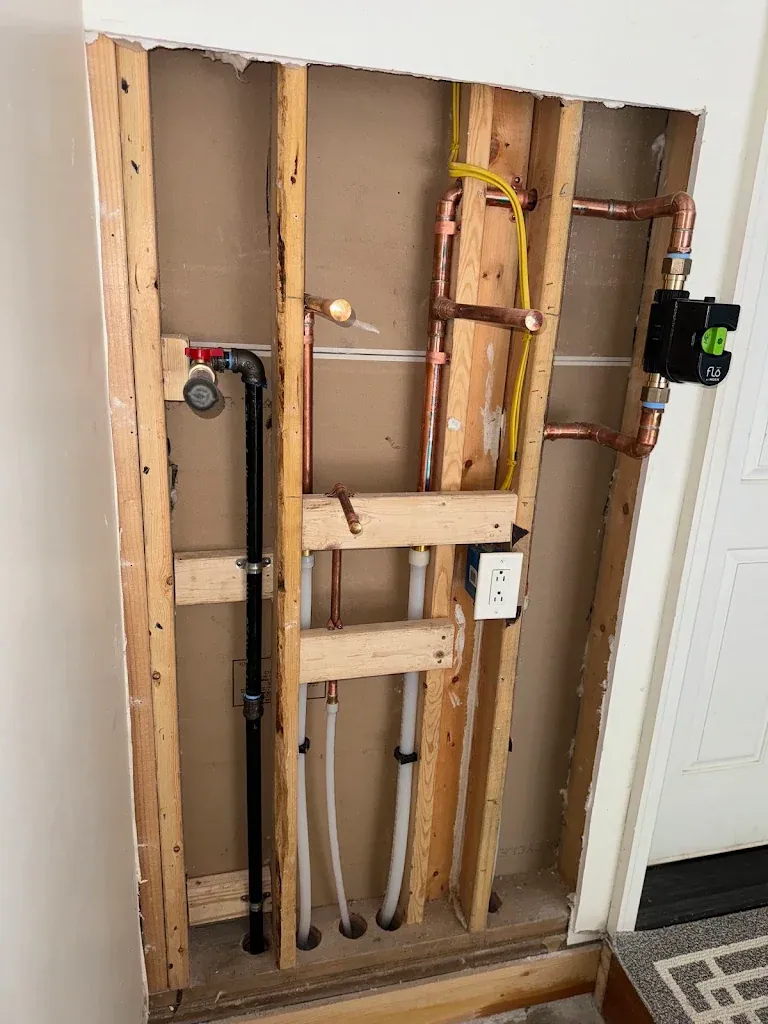
A smart shutoff valve is a motorized ball valve with sensors, installed on the main water line where it enters the house. The unit we install most often is the Flo by Moen, and others work on the same principle. It measures flow rate, pressure and temperature continuously and reports to an app on your phone over Wi-Fi. For the first week or so it learns the house: how much water a shower uses, how long the washing machine runs, what the morning looks like.
After that it watches for two kinds of trouble. The first is a burst: a flow rate far above anything the house normally does, sustained for more than a short time. The second is a drip that never ends: a small flow that continues for hours when the house should be quiet, which is what a cracked supply line under a sink, a failed washing machine hose, or a running toilet looks like from the main. In either case it sends an alert, and if nobody responds, it closes the valve on its own.
It also runs a health test each night. With no water being used, it closes the valve briefly and watches the pressure in the house piping. If the pressure drops, water is leaking out somewhere, even at a rate too small to register as flow. That catches pinholes and weeping fittings that would otherwise run inside a wall for months.
What it catches that a leak sensor does not
Battery-powered leak sensors, the pucks you put under the water heater and behind the washing machine, detect water once it is on the floor at that spot. They are useful and cheap, and some systems pair them with a shutoff so a wet puck closes the valve. But they only know about the places you put them. A supply line that fails inside a wall, a slab leak, a toilet that cracks at the tank, a crawlspace pipe that lets go: no puck sees those.
A main-line device sees all of them because every one of them pulls water through the main. It does not know where the leak is, but it knows water is going somewhere it should not, and it can stop it. For a leak the device cannot locate, the app's history tells you when the flow started and how much ran, which narrows the search when you or we go looking.
The honest limitation is that it only sees water that passes through it. A leak in the service line between the meter and the house, a well problem, or a pressure tank in the pump house are upstream of the valve and invisible to it. Sewer backups, drain leaks and crawlspace flooding from groundwater have nothing to do with the supply and are not detected.
Who it makes the most sense for around here
The homes that benefit most are the ones where a leak can run a long time before anyone notices. That describes a lot of our service area. Second homes and cabins in Mason County and along Hood Canal sit empty for weeks. Rentals between tenants sit empty for a month. Naval Base Kitsap, Bangor and PSNS families deploy or travel for months, and so do retirees who go south for the winter. A failed toilet supply line in any of those houses runs until someone opens the door.
Second are homes with finished space below the plumbing: a two-story house in Gig Harbor North or Silverdale with bathrooms over the living room, a daylight basement in Bremerton, a condo over a neighbor. A supply line leak upstairs in those homes damages ceilings, floors and everything in them within hours.
Third are homes on wells with a submersible pump and a large pressure tank, where a leak in the house will run the pump continuously and can burn it out while flooding the crawlspace, and homes at the end of long service lines on steep waterfront lots where the pipe has already had problems. And anyone who has had one water damage claim already knows what the second one would cost in premiums.
- Seasonal homes and cabins that sit empty
- Rental properties, especially between tenants
- Households that travel or deploy for extended periods
- Two-story homes and condos with living space below bathrooms
- Well homes where a leak also endangers the pump
- Anyone who has already had a water damage claim
The freeze question
After the December 2022 and January 2024 cold snaps we were asked often whether a smart shutoff would have prevented the damage. The answer is partly. The device does not keep a pipe from freezing and does not know a pipe has frozen until it thaws and starts leaking. What it does is close the main the moment that split begins to flow, which is exactly the moment when most freeze damage happens. A house that would have had water running through the crawlspace and up through the floor for a day instead has a few gallons on the ground and a closed valve.
Flo by Moen also reports water temperature at the main, and it will alert if the incoming water gets close to freezing, which is an early warning for a crawlspace line in trouble. The valve itself needs to be installed where it will not freeze; a device frozen solid at the main is not helping anyone.
For a vacant house in winter, the combination that works is the smart valve plus the heat left on plus someone who can respond to the alert. For a house that will be drained and winterized, the valve is simply closed for the season.
Installation requirements
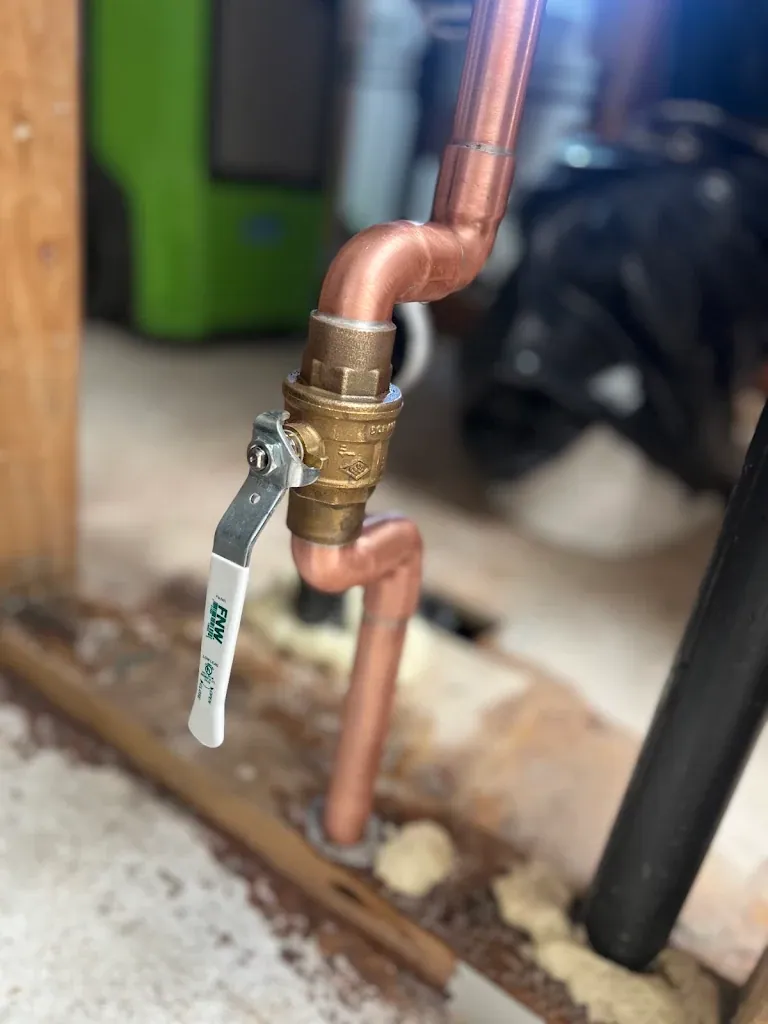
The device goes on the main line after the manual shutoff, before any branch, so that everything in the house is downstream. On most Kitsap homes that is in the crawlspace near where the service line comes in, in the garage, or at the water heater closet in newer construction. It needs a straight section of pipe long enough for the unit, a power outlet within reach of its cord, and Wi-Fi strong enough to reach it. Crawlspaces are the weak point for both power and signal, and sometimes the right answer is to bring the main up through the floor into a utility closet, add an outlet, and install the device where you can see it.
The pipe size should match the service: three-quarter or one inch for most homes. If the house has no accessible manual shutoff, or the existing one is a seized gate valve, that gets replaced with a ball valve at the same time. If the house has no pressure reducing valve and street pressure is high, which it often is at the bottom of Port Orchard's hills, the PRV goes in ahead of the device, and the device will then show you if the PRV starts to fail.
Installation is a few hours and is done by a plumber, not an electrician, though the outlet may need one if there is none nearby. Washington requires a permit for work on the main water line, and the device should be pressure tested like any other main line work.
Living with it
The app shows daily water use by fixture type as it learns, which is interesting for about a week and then becomes useful when something changes. A toilet that starts running shows up as a step up in daily usage. An irrigation zone with a broken head shows up as a spike at six in the morning. The pressure readings show whether a PRV is drifting.
False alarms happen early on. Filling a hot tub, running a hose for hours or a long irrigation cycle can look like a burst to a device that has not seen it before. The app lets you confirm that a flow is intended, the device learns, and the alarms settle down. There is also an away mode that tightens the thresholds when the house is empty, which is the setting that makes the device worth having for a vacant home.
Power and Wi-Fi outages are the practical concern. The valve stays in whatever position it was in when power was lost, which means it does not fail closed. During the windstorms that follow our freezes, a house with no power also has no leak monitoring. A small uninterruptible power supply on the outlet covers short outages.
The insurance angle and the bottom line
Water damage from supply line failures is one of the most common homeowner claims, and insurers have noticed that automatic shutoff devices reduce the size of those claims dramatically. Many carriers now offer a discount on the premium for a professionally installed main-line shutoff, and some offer it only for specific devices with professional installation documentation. Ask your agent before you buy. In some cases the discount recovers a meaningful share of the installation over a few years, before counting the claim it may prevent.
Whether it is worth it comes down to the question of what a long-running leak would cost you. In an occupied single-story house in Port Orchard on a slab with a floor drain in the garage, a leak gets noticed fast and the device is a convenience. In a two-story Gig Harbor house that sits empty every February while the owners are in Arizona, or a Hood Canal cabin that nobody visits between October and May, a leak is a gutted house, and the device is cheap insurance that actually does something.
We install Flo by Moen devices across the three counties, usually with a new ball valve and sometimes a PRV, and we set up the app and the away mode before we leave. If what you have is a vacant house and a worry, this is the fix.
Frequently asked
Will a smart shutoff valve detect a leak in my crawlspace?
If the leak is in the supply piping, yes, because water leaving through the leak passes through the device. If the crawlspace water is from groundwater or a drain line, no. The device only sees the pressurized supply side.
Does it work on a well?
Yes, installed on the line from the pressure tank into the house. It protects the house and, by closing the valve, keeps the pump from running continuously into a leak. It does not monitor the well or the pressure tank themselves.
What happens if the power or Wi-Fi goes out?
The valve stays in its current position and does not monitor until power and connection return. A small battery backup on the outlet covers short outages. Nothing about it fails closed, so you still have water.
Can I install it myself?
It is a main water line installation that requires cutting the pipe, and in Washington that is permitted plumbing work. Insurers that give a discount usually require professional installation documentation. We install it, test it and set up the app.
Will it shut off the water while I am in the shower?
Not once it has learned the house. A shower is normal flow. The device alerts before it acts on anything, and you can confirm from the app that a long fill or a hose is intended. Early false alarms are the learning period, not a permanent problem.
Is it better than leak sensors under the water heater?
They do different jobs. Sensors detect water on the floor in one spot. A main-line device detects water leaving the pipes anywhere in the house. Both together, with sensors paired to the valve, is the thorough setup.
About the author. Gregory Lowe is the owner and lead plumber at Washington Plumbing & Drain, a veteran-owned company in Port Orchard serving Kitsap, Pierce and Mason counties. The guidance here comes from daily work in local homes, not from a content farm. Call (360) 812-1124 with questions.