
Short answer
Turn off every fixture and appliance in the house, then watch the small leak indicator on your water meter: a tiny triangle, star or gear on an analog dial, or a flow icon or trickling-drop symbol on a digital one. If it moves with everything off, water is leaving the system somewhere. Close the main shutoff at the house and look again. Still moving means the leak is in the service line between the meter and the house; stopped means it is inside, and the toilets are the first suspects.
In this guide
Key takeaways
- The meter is the one instrument that sees every drop entering your property. Use it before tearing anything open.
- The leak indicator is the small spinner or flow icon, not the big sweep hand. It shows flows too small to register on the main dial.
- The two-position test, main valve open then closed, splits the problem into inside the house or underground service line.
- A ten-minute reading with everything off, converted to gallons, tells you how serious the leak is and gives your plumber a number to work with.
- Toilets, a weeping water heater relief valve, a dripping hose bib and a running irrigation zone cause most indoor leak readings.
- Well homes have no meter, but a pressure gauge and the pump's cycling behave the same way for this test.
Find the meter and open the box
If you are on Kitsap PUD, West Sound Utility District, City of Port Orchard, City of Bremerton, Silverdale Water, Poulsbo, Tacoma Public Utilities or any of the smaller districts, there is a meter box at the edge of your property, usually near the street or at the end of the driveway. It has a cast iron, concrete or heavy plastic lid, often with a small hinged flap in the middle for the meter reader. Lift the lid with a flat screwdriver or a meter hook. Watch for spiders, slugs and the occasional frog; these boxes are wet most of the year.
Inside you will see the meter body with a register on top. Older ones have a glass-faced analog register with a sweep hand and a small spinning indicator. Newer ones, which most local utilities have switched to over the last decade, have a digital display that may need a flashlight shone on it for a few seconds to wake it up. There will be a valve on one or both sides of the meter.
On long driveways in Olalla, Burley, Wauna and the Key Peninsula, the meter may be hundreds of feet from the house. That distance matters later, because every foot of service line between the meter and the house is a place a leak can hide.
Reading an analog meter
The big odometer-style numbers are total consumption, in cubic feet or gallons depending on the utility. Most local utilities bill in hundreds of cubic feet, and one cubic foot is roughly seven and a half gallons. The sweep hand goes around once per cubic foot or per ten gallons. The small triangle, star, snowflake or gear near the center is the leak indicator, and it turns with flows too small to move the sweep hand visibly.
For a leak test, you care about the small indicator first. If it is turning at all with the house shut down, water is moving through the meter. For measuring, note the full reading including the sweep hand position, wait, and read again.
Reading a digital meter
Digital registers show a number, a unit, and usually a flow rate or a flow icon. Some show a faucet or a droplet symbol that appears when any flow is detected, and some utilities' meters display a leak flag if continuous flow has been recorded for an extended period. If yours shows a flow rate in gallons per minute, you have the best leak test available; a reading of anything above zero with the house off is your answer.
If the screen is dark, shine a flashlight on the solar cell or small sensor window for a few seconds. Some displays cycle through screens on their own; wait for the one with the flow rate. If you cannot make sense of it, the utility's website typically has a guide for the specific meter model they use, and many local utilities now offer customer portals that show hourly usage, which makes a continuous overnight flow obvious on a graph.
The whole-house test
Turn off everything that uses water. Faucets, showers, the dishwasher and washing machine, the ice maker, irrigation, a hot tub autofill, a water softener or filtration system that backwashes on a timer, and any humidifier on a furnace. Tell the household not to flush for the next twenty minutes. Then go look at the meter.
If the leak indicator is dead still for a couple of minutes, you do not have a continuous leak. A high bill in that case usually traces to an intermittent problem, like a toilet that runs only sometimes or an irrigation zone that sticks open, or to a billing or meter issue. If the indicator moves, go to the next test.
Write down the reading, wait ten minutes without using any water, and read again. The difference, converted to gallons, times six, is your hourly loss. Times 144 is your daily loss. A leak that moves a cubic foot in ten minutes is losing more than a thousand gallons a day, which is a line break, not a flapper.
- All faucets and showers off, no flushing
- Dishwasher, washer, ice maker, water softener and filtration backwash off
- Irrigation controller off, hose bibs closed, hot tub autofill off
- Note the reading, wait ten minutes, read again
Inside or underground: the main valve test
With the meter still moving, go to the main shutoff valve at the house and close it. If you are not sure where it is, our guide to shutting off the water covers every common spot. Go back to the meter. If the indicator has stopped, the leak is inside the house or in something attached to it, past the main valve. If it is still turning, the leak is in the service line between the meter and the house, or in a branch off that line to an outbuilding, irrigation or a hose bib tee.
This one test saves a lot of money. A leak that is underground on a long service line gets located with listening equipment and repaired with a dig; one inside gets found by looking at toilets and fixtures first. We bring different tools for each, and knowing which before we arrive means the right truck comes.
A caution: if your main valve is an old gate valve that does not fully close, the test is unreliable. A valve that will not seal is itself worth replacing, and we will tell you if that is what we find.
When the leak is inside: the usual suspects
Toilets are first, and it is not close. A flapper that does not seal lets water trickle from the tank into the bowl, the fill valve tops the tank up, and the cycle runs all day silently. Put a few drops of food coloring in each tank, wait fifteen minutes without flushing, and look for color in the bowl. A fill valve set too high overflows into the overflow tube and makes the same reading.
After toilets: the temperature and pressure relief valve on the water heater, which may be dripping into a drain line you cannot see; a hose bib dripping into the mulch; a humidifier or ice maker line; a water softener stuck in regeneration; and a pinhole in a crawlspace line dripping onto the plastic vapor barrier where nobody looks. In older homes with slab sections, a warm spot on the floor points to a hot water line leaking under the slab.
Check the crawlspace. Puget Sound crawlspaces are damp anyway, so look for a spot that is wetter than the rest, a drip trail on a pipe, or a sagging patch of insulation under a bathroom.
When the leak is in the service line
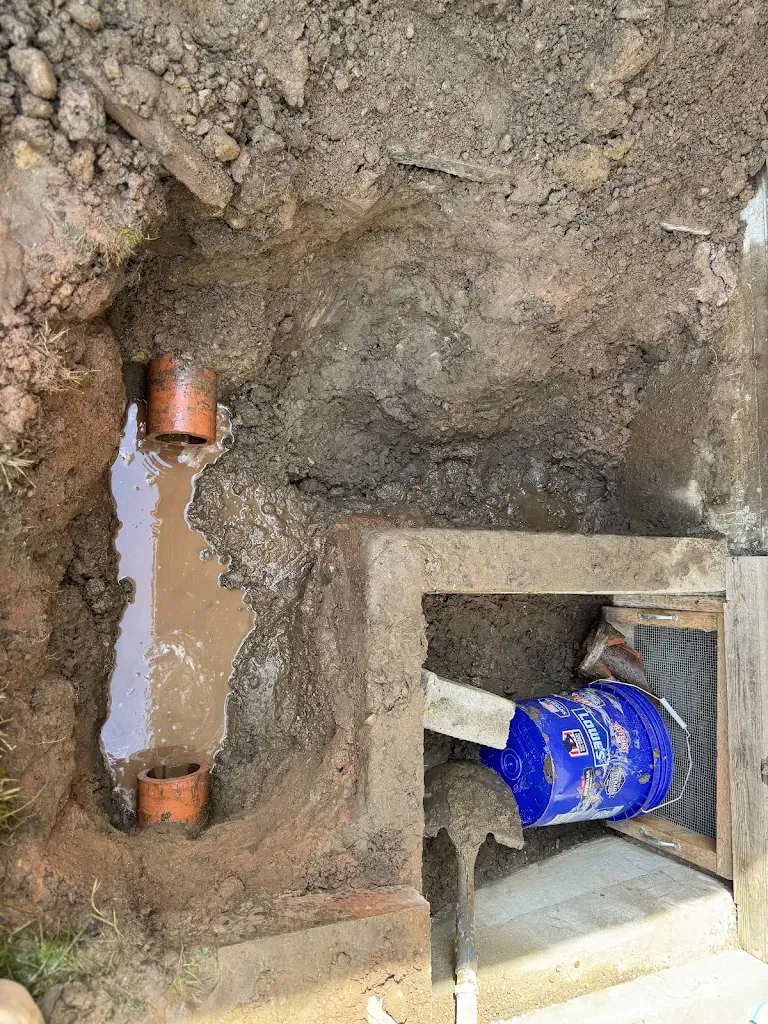
Service lines around here are copper, galvanized steel, polyethylene black plastic, or, in some 1980s and 90s homes, polybutylene. Galvanized and polybutylene fail with age. Copper fails where it was bedded in sharp rock or passed through a foundation without a sleeve. Poly fails at the insert fittings. A leak may surface as a soft, green patch in the lawn in August, a wet spot at the foundation, or nothing at all when the water drains straight down through sandy glacial outwash.
On a long run, we locate rather than guess. Acoustic listening equipment picks up the hiss of pressurized water escaping, and a leak correlator or a tracer gas can pin it down on a very long line. For short lines and old materials, a full replacement in new polyethylene or PEX is often the better call than chasing one pinhole in a pipe that will spring another next winter. Either way, you get a flat price before the shovel goes in.
If you are on a well
No meter, but the same logic. Close every fixture, then watch the pressure gauge at the tank and listen for the pump. If the gauge slowly falls and the pump kicks on with nothing running, water is leaving the system. Close the valve on the house side of the tank; if the pump still cycles, the leak is between the well and the tank or in the tank itself. If it stops cycling, the leak is in the house.
A leaking check valve at the pump or a hole in the drop pipe inside the well casing can mimic a leak, and so can a waterlogged pressure tank. Our well house and pressure tank page covers how we tell those apart.
Frequently asked
What is the little triangle on my water meter?
That is the leak or low-flow indicator. It spins when any water passes through the meter, even flows too small to move the main sweep hand. If it moves with every fixture in the house off, water is escaping somewhere.
Can I shut off the valve at the meter myself to do this test?
For the inside-versus-underground test, use the main valve at the house rather than the meter valve. The meter valve belongs to the utility; most allow emergency use but prefer you not operate it routinely. If you have no working house valve, that is a reason to have one installed.
My meter does not move but my bill is still high. Why?
The leak may be intermittent, like a toilet that runs only after certain flushes or an irrigation zone that sticks open some mornings. Check a utility usage portal for the hourly pattern if yours offers one. It can also be a misread or an estimated bill; call the utility and ask them to reread the meter.
How much water does a running toilet waste?
A badly leaking flapper can run hundreds of gallons a day; a slight one can still add up to a noticeable bill over a month. The food coloring test takes fifteen minutes and costs nothing.
The meter still moves with the house valve closed. Does that mean I need a new service line?
It means the leak is between the meter and the house. Whether we repair the spot or replace the line depends on the pipe material, its age and length, and how it is routed. We locate it first and give you both options in writing.
Will the utility help me find a leak?
Most local utilities will confirm the meter is reading correctly and some will do a quick leak check at the meter, but anything on the house side of the meter is the homeowner's responsibility. That is where we come in.
About the author. Gregory Lowe is the owner and lead plumber at Washington Plumbing & Drain, a veteran-owned company in Port Orchard serving Kitsap, Pierce and Mason counties. The guidance here comes from daily work in local homes, not from a content farm. Call (360) 812-1124 with questions.