
What it usually looks like
- The handle will not turn at all, or turns only with a lot of force
- The handle spins freely and nothing happens
- The valve closes but water still runs at the faucets
- The stem weeps water around the packing nut when the valve is turned
- The handle is missing, broken or corroded to a green lump
- You cannot find a main shutoff anywhere inside the house
Likely causes, most common first
Corroded gate valve stem
Gate valves were the standard main shutoff for decades. The stem threads through a packing nut, and if the valve sits untouched for twenty years, minerals and corrosion lock the threads. The handle will not turn, and forcing it twists the stem off at the gate. Nearly every original shutoff in the 1950s to 1980s homes around Bremerton, Port Orchard and Tacoma is one of these.
The gate has separated from the stem
Inside a gate valve, a brass wedge rides up and down on the stem. The wedge can break off its threads and drop to the bottom. The handle then turns freely with no effect, and the valve is stuck in whatever position the wedge landed in, which is usually partly open.
Scale or debris under the gate
A gate valve that closes most of the way but still passes water has mineral scale, a pebble or a flake of pipe on the seat. It will not seal, and grinding it harder only scores the seat. On well water with iron and sediment this is common.
Failed packing
The packing around the stem dries out after years without being turned. The first time someone operates the valve in an emergency, it leaks at the stem. Snugging the packing nut sometimes helps; the valve is still at the end of its life.
Multi-turn stop or curb valve outside has the same problem
Some homes only have a shutoff at the meter or a curb stop in the yard. Those get buried, flooded in the meter box during the rainy season, and seize just like an indoor gate valve, which leaves the homeowner with no working shutoff anywhere.
Safe things to check yourself first
- Stop forcing it. If moderate hand pressure does not turn the handle, leave it alone. A snapped stem is a much bigger problem than a stuck one.
- Try a few drops of penetrating oil on the stem and packing nut, wait, and try closing with steady pressure in both directions. Working the valve slightly open first sometimes frees it.
- Loosen the packing nut a quarter turn to relieve binding on the stem, then try again, and retighten it afterward.
- Locate the meter shutoff at the street. Kitsap, Bremerton and Port Orchard meters have a stop in the meter box that turns with a meter key or an adjustable wrench. Confirm you can operate it before you need to.
- If you are on a well, the shutoff at the pressure tank or the pump breaker is your emergency stop. Know where both are.
- Tag the working shutoff with a label so anyone in the house can find it, and show every adult where it is.
Stop and call if
- A pipe is leaking and you cannot close the main or the meter stop
- The stem snapped, the handle came off in your hand, or the valve is now leaking from the stem
- The valve is a gate valve on a home more than thirty years old and has never been replaced
- You are about to have other plumbing work done and the shutoff cannot isolate the house
- There is no shutoff at all between the meter and the house
How we diagnose and fix it
- Shut the water at the meter stop or the pressure tank, drain down the house, and cut out the old gate valve.
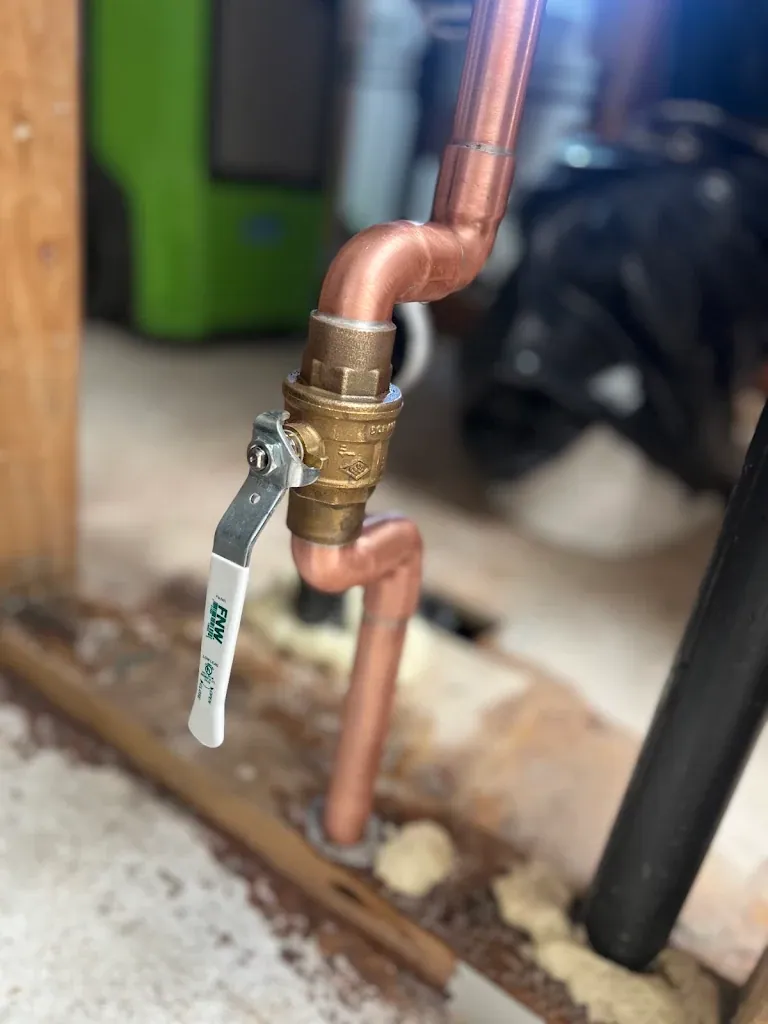
- Install a full-port quarter-turn ball valve, usually an FNW or similar brass valve, with a lever handle you can close in a second, oriented so it can actually be reached.
- Add a second valve or a drain-down fitting where it helps, such as a hose bib after the main for draining the house in winter.
- Relocate the main shutoff indoors or to an accessible location when the only valve is in a flooded meter box, a tight crawlspace or behind a finished wall.
- Replace or free a seized curb stop in coordination with the water utility when the meter-side valve is the one that fails.
- Offer a Flo by Moen smart shutoff for homes where automatic leak protection makes sense, such as vacation houses on Hood Canal or rentals.
Around Kitsap, Pierce and Mason counties
Most of the shutoffs we replace are original gate valves in crawlspaces across South Kitsap and Bremerton, often right where the water line comes up through the floor, surrounded by insulation and spider webs. Waterfront and hillside homes sometimes have the only shutoff in a meter box at the top of a long driveway, which fills with water every winter. During the January 2024 freeze, several of our burst-pipe calls were made worse because the homeowner spent half an hour trying to find or turn a valve that had not moved since the house was built. A working shutoff is the cheapest insurance you can buy.
Questions people ask
Can you replace the main shutoff without turning off the street?
No. We close the meter stop or curb stop to do the work. If that valve is also seized, we coordinate with the utility, who can shut the service at the main. On a well, we shut the pump and drain the tank.
Which is better, a gate valve or a ball valve?
A ball valve, without question. It closes in a quarter turn, seals reliably after years of sitting, and you can tell at a glance whether it is open or closed by the handle position. There is no reason to install a gate valve as a main shutoff anymore.
Why does my valve leak at the handle when I turn it?
The packing has dried out. Tightening the packing nut slightly may stop it for now, but a valve that leaks at the stem is telling you it is worn out. Plan on replacing it before it matters.
Where should the main shutoff be?
Where the water line enters the house, at a height and location an adult can reach without crawling, and ideally with a clear path to it. Garages, utility rooms and the wall behind an access panel are all good. A crawlspace is better than nothing but not ideal.
Should I exercise the valve once in a while?
Yes. Close and reopen the main shutoff fully once or twice a year so it does not seize. Do the same with the valves under sinks and behind toilets. A valve that gets moved stays movable.