Short answer
A tank water heater stores forty to eighty gallons of hot water and reheats it around the clock; a tankless heater fires only when a tap opens and heats water as it passes through. In Kitsap County, tankless makes the most sense for gas or propane homes with a busy household, limited space, or a desire never to run out, and it needs yearly descaling and a large gas supply. A tank remains the better fit for all-electric homes without a big service upgrade, for wells with heavy minerals and no treatment, for cabins used a few weeks a year, and for anyone who wants the lowest upfront cost and simplest service. Both are good choices when they are matched to the house.
In this guide
Key takeaways
- Our groundwater arrives at the heater cold, often in the forties in winter. That matters more for tankless sizing than almost anything else.
- Gas and propane tankless units are the ones that deliver the endless-hot-water experience. Electric tankless rarely works for a whole house here.
- Tankless units last longer, take up less room and avoid standby loss, but they need annual descaling and the right gas line and venting.
- Tanks are cheaper to install, simpler to service, and the right answer for many electric-only homes. Heat pump tanks change that math for the better.
- Well water with iron or hardness, which is common in Mason County and rural Kitsap, needs treatment before a tankless or the heat exchanger will scale up fast.
- The best answer depends on fuel, household size, space and water quality. We install both and will tell you which one your house wants.
How each one actually works
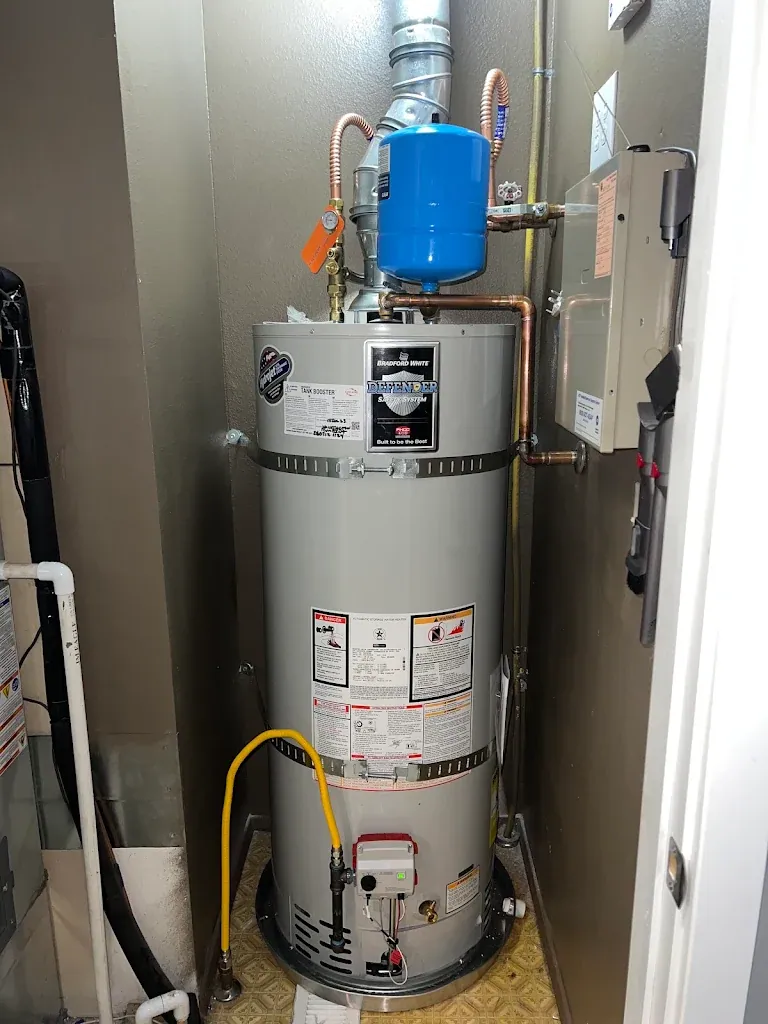
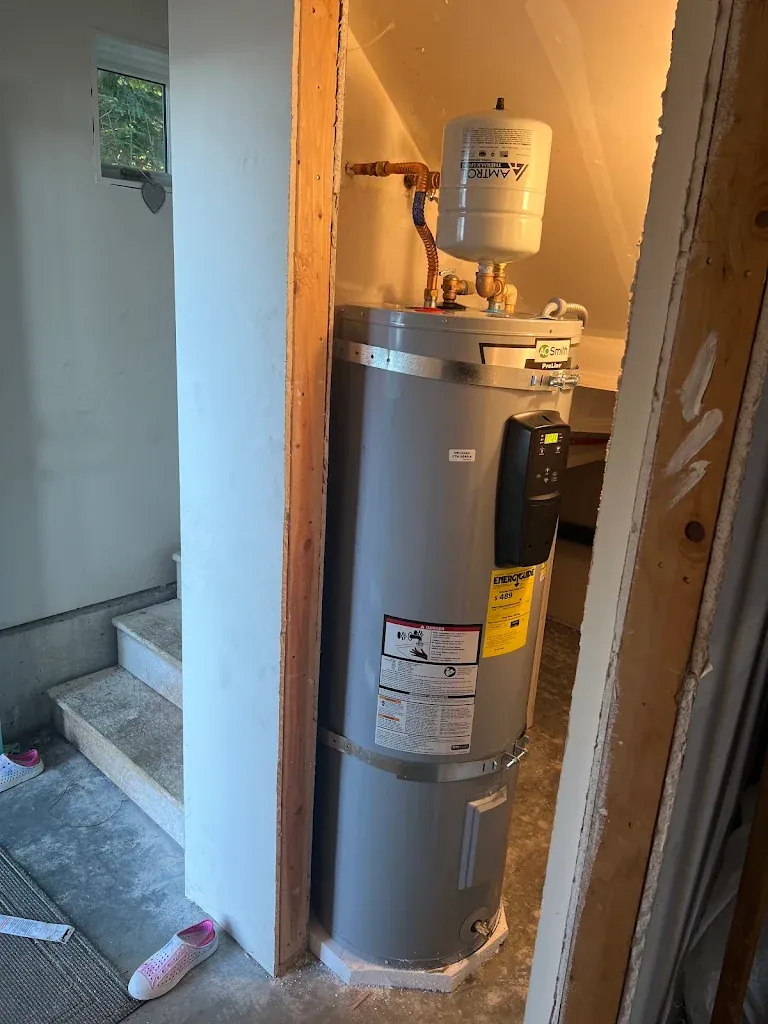
A tank heater is a steel cylinder with a glass lining, an anode rod to protect the steel, and either a gas burner underneath or two electric elements inside. It holds a set volume of hot water, loses a little heat through its insulation all day, and reheats to keep the thermostat satisfied. When you draw hot water, cold water enters at the bottom and the tank slowly cools until the burner or elements catch up. Run it empty and you wait for recovery.
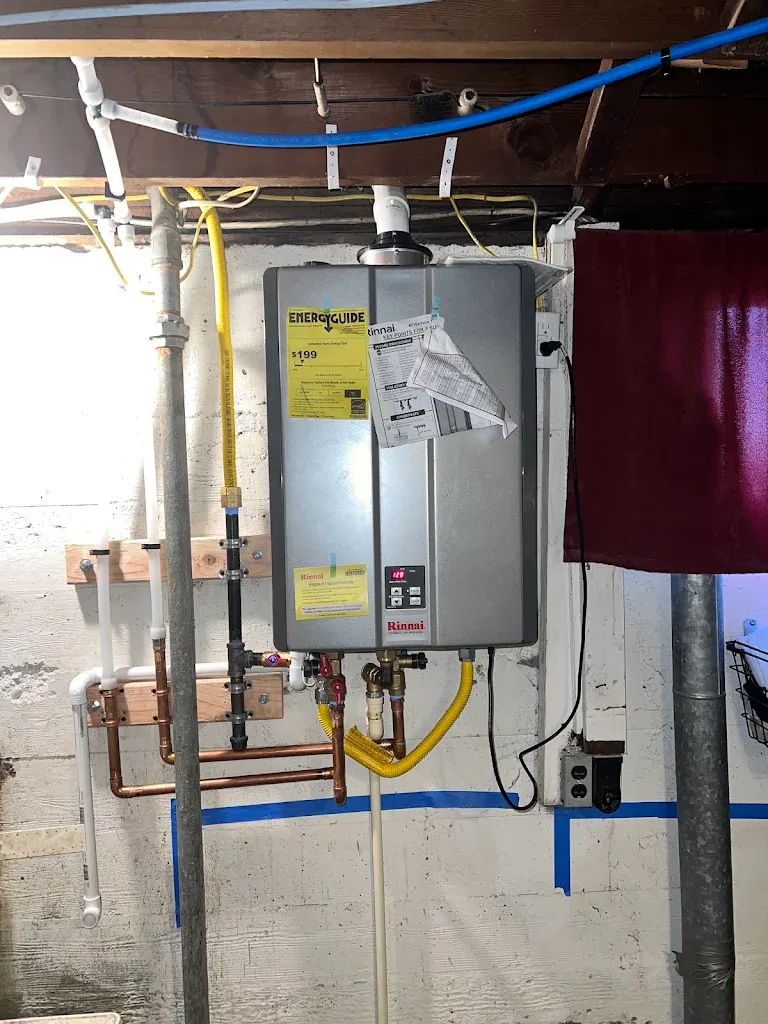
A tankless heater, like the Rinnai units we install most often, is a heat exchanger with a burner that modulates. A flow sensor sees water moving, the burner lights, and the water picks up heat on its way through. As long as the burner can raise the incoming water to your set temperature at the rate you are pulling it, hot water does not run out. Pull more than it can heat and the unit either reduces flow or lets the temperature drop, depending on the model and settings.
The difference that people feel: a tank gives full flow until it is empty, then nothing. A tankless gives steady hot water forever, within a flow limit. Which limit you hit depends on the house.
The cold water problem in Western Washington
Tankless sizing comes down to temperature rise: how far the heater must raise the incoming water to reach your setpoint. Manufacturers advertise flow rates at a modest rise, and in a warm climate that number is close to real life. Here it is not. Groundwater feeding Kitsap PUD, West Sound, Bremerton and the private wells in Seabeck or Belfair comes into the house in the mid-forties to low fifties through the winter. To get a 120-degree shower, the heater needs a seventy-degree rise or more.
At that rise, a residential gas tankless delivers roughly half the flow printed on the box. That is still plenty for one shower and a sink at the same time, and a larger unit or two units in parallel handle a big household, but it is why we size on the January number, not the August one. A tankless that was sized off the brochure is the one that goes lukewarm when the second shower starts.
Tanks care about cold water too, just differently. Colder inlet means slower recovery and slightly more mixing, so a fifty-gallon tank feels a little smaller in February than in July. The fix there is simple: size the tank for the household and set it right.
Fuel: gas, propane and electric around here
Natural gas from Cascade Natural Gas reaches parts of Kitsap, mainly Bremerton, Port Orchard, Silverdale and the Highway 3 and 16 corridors, and Puget Sound Energy serves gas in Gig Harbor, Tacoma and the rest of Pierce County. A gas tankless on those lines is a strong option. Most need a 3/4-inch gas line and sometimes a larger meter, because a tankless burner can draw several times what a tank burner does when running flat out. We check the gas supply before we quote one.
Propane is the rule in Mason County and much of rural Kitsap and the Key Peninsula. Propane tankless works well and is the most common tankless install we do on well-and-septic properties. The difference is the tank outside: a propane tankless pulls hard from the tank, and a small tank or an undersized regulator causes the unit to fault on low gas pressure in cold weather. We coordinate with your propane supplier on tank size and regulator.
All-electric homes, which include a great many Kitsap PUD and Peninsula Light customers and most of the older Navy-era housing, are where tankless gets difficult. A whole-house electric tankless able to make a seventy-degree rise needs a very large electrical service and multiple breakers, and many panels simply cannot. For those homes, a good electric tank, or increasingly a heat pump water heater, is the better answer. Point-of-use electric tankless under a far bathroom sink is a reasonable use of the technology; a whole-house electric tankless usually is not.
Where a tankless wins
Households that run out of hot water. A family with teenagers, a home with a big soaking tub, or a multi-generational house in Gig Harbor where showers stack up in the morning is the classic case. Within its flow limit, a tankless does not run out, and that ends the argument about who showers first.
Space. A tankless hangs on the wall the size of a small suitcase and vents through a side wall with PVC or stainless pipe. In an older Bremerton house where the tank sits in a closet you would like back, or a small Port Orchard condo, that is a real gain. It also gets the heater out of the garage, which matters after what the 2024 freeze did to garage tanks.
Longevity and efficiency. A well-maintained tankless should run around twenty years to a tank's eight to twelve, and it does not spend energy keeping forty gallons hot while you are at work on the base. Modern condensing units pull more heat from the exhaust and vent in plastic pipe, which simplifies installation in a lot of homes.
Where a tank wins
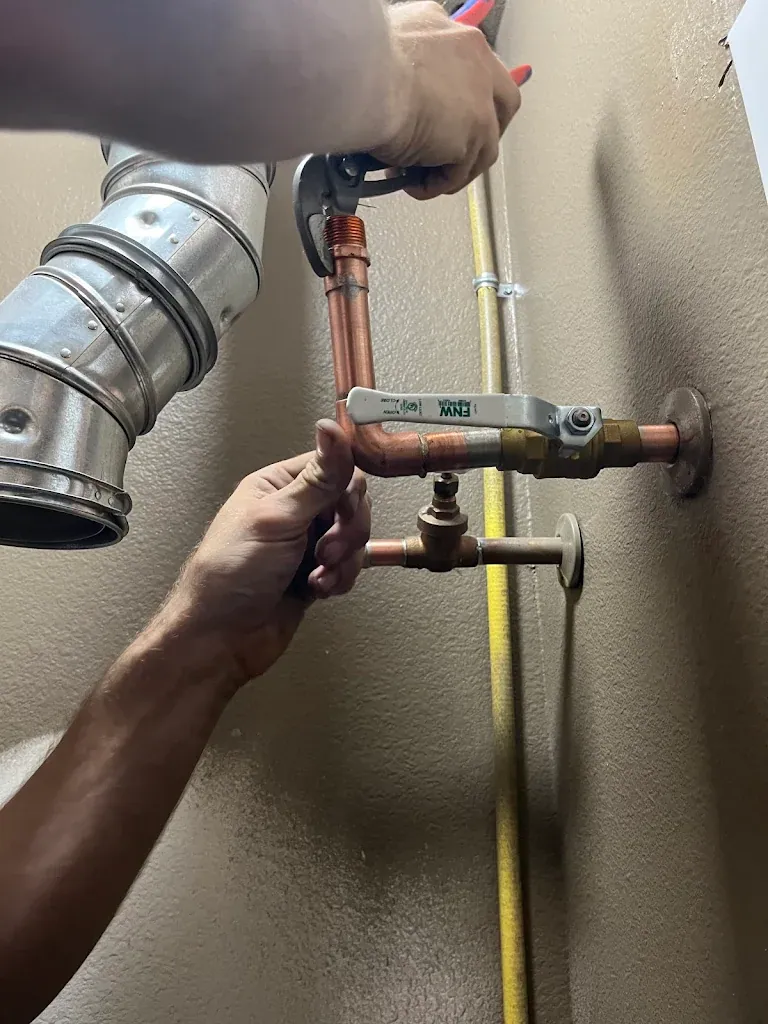
Upfront cost and simplicity. A tank replacement is a same-day job with no new gas line, no new venting and no electrical work. Service is simple: elements, thermostats, a gas valve, an anode. Any plumber can work on one. A tankless install is a four-figure project with more parts, and the first one in a house often involves gas and vent work that the tank never needed.
Electric homes. As above, a tank is the practical electric choice, and a heat pump tank in a garage or utility room does the same job on a fraction of the electricity. It needs some air space and a condensate drain, and it cools the room it sits in, which is a feature in a garage and a drawback in a closet.
Untreated well water and light use. Iron, manganese and hardness scale a tankless heat exchanger quickly, and a cabin in Tahuya or Hoodsport that is used a few weekends a month does not benefit from endless hot water. A tank tolerates rough water longer and sits idle without complaint. If you want tankless on a well, plan on filtration or a softener first.
Simultaneous heavy draws. Filling a large tub while two showers run and the dishwasher cycles will push a single residential tankless past its flow limit on a cold morning. A large tank, or a tankless paired with a small buffer tank, handles it.
Maintenance: what each one asks of you
A tank wants a few gallons drained from the bottom valve yearly to flush sediment, the relief valve tested, and the anode rod checked around year four or five and replaced when it is mostly gone. Do that and a tank in our soft municipal water gets to the long end of its life. Skip the anode and it does not.
A tankless wants a descaling flush every year, which means circulating a mild acid through the heat exchanger with a pump for about an hour, cleaning the inlet screen, and checking the condensate line and the venting. We install isolation valves on every tankless so this is quick. Manufacturers tie warranty coverage to it. A tankless that has gone ten years without a flush often needs a heat exchanger, which is most of the cost of a new unit. Our descaling and maintenance guide goes into the how and why.
Installation details that decide whether you will be happy
Venting. Non-condensing gas tankless units need stainless vent pipe and a careful route; condensing units vent in PVC and produce acidic condensate that has to go to a drain through a neutralizer. We look at where the unit can hang relative to an exterior wall and a drain before we promise anything.
Gas supply. We size the line from the meter or the propane regulator to the unit for its full input plus everything else on the system. Skipping this is the most common cause of tankless units that flash error codes in January.
Water quality and recirculation. On well water we test and treat first. On long runs to a far bathroom, we talk about a recirculation loop or a unit with built-in recirculation, because a tankless does not fix the wait for hot water at the far end of a rambler in Silverdale; it can make it slightly longer. And every install, tank or tankless, gets a permit, seismic strapping where it applies, a correctly piped relief valve, and an expansion tank if the house has a pressure reducing valve or backflow device.
- Confirm fuel and gas line or electrical capacity before choosing
- Size on winter inlet temperature, not the brochure rating
- Treat well water before a tankless goes in
- Plan the vent route and condensate drain
- Install isolation valves so descaling is painless
How we help you decide
We ask about the household, look at the fuel and the panel, check the water, and measure the space. Then we give you a flat-rate quote for the option that fits, and if two options fit we quote both and explain the trade. We have told plenty of homeowners that the tankless they came in wanting was not right for their all-electric 1965 house, and plenty of others that their gas home with four kids was wasting money on a fifty-gallon tank. Reviews mention that we explain the options and let people choose, and that is the plan here too.
Frequently asked
Is a tankless water heater worth it in Kitsap County?
For a gas or propane home with a busy household, limited space, or a tank that keeps running out, usually yes, provided the gas supply and venting can support it and someone will descale it every year. For an all-electric home or an untreated well, a tank or a heat pump tank is often the better buy.
Can a tankless water heater keep up in winter here?
A correctly sized one can. The trick is sizing for the forty-something-degree inlet water we get from November through March, which roughly halves the flow number printed on the box. We size for the cold months so the second shower in January still has hot water.
Do you install electric tankless water heaters?
For point-of-use at a remote sink, yes. For a whole house, rarely, because the electrical load needed to heat our cold water fast enough exceeds what most panels can supply. We will look at your panel and tell you.
What about a tankless on well water?
It works if the water is treated. Iron, manganese and hardness scale the heat exchanger fast. On most Mason County and rural Kitsap wells we recommend a sediment filter and, depending on the test, a softener or iron filter before a tankless.
How long does each type last?
A tank, eight to twelve years here with a working anode. A tankless, around twenty with annual descaling. Both numbers drop on untreated well water or in a garage that saw the recent hard freezes.
Will a tankless fix the long wait for hot water at my far bathroom?
No. That wait is the cold water sitting in the pipe between the heater and the tap, and a tankless does not change it. A recirculation pump or a unit with built-in recirculation does.
Do I need a bigger gas line for a tankless?
Often. A tankless burner draws several times what a tank burner does when running flat out. We size the line from the meter or regulator and will tell you if it needs upsizing before quoting the job.
About the author. Gregory Lowe is the owner and lead plumber at Washington Plumbing & Drain, a veteran-owned company in Port Orchard serving Kitsap, Pierce and Mason counties. The guidance here comes from daily work in local homes, not from a content farm. Call (360) 812-1124 with questions.