What it usually looks like
- Every faucet and shower in the house runs weak, not just one
- Pressure drops sharply when a second fixture opens
- The problem came on suddenly after street work, a freeze, or a new water heater
- On a well, pressure surges and fades in a cycle
- The first floor is tolerable but the upstairs bathroom is a trickle
- A hose bib gauge reads well under 40 psi
Likely causes, most common first
A failed pressure reducing valve
Most homes on district water with high street pressure have a bell-shaped PRV near the main shutoff. The spring and diaphragm inside wear out, and the valve can fail in either direction. When it fails closed, the whole house drops to a trickle. PRVs last roughly ten to fifteen years, and many around here are older than that.
The main shutoff is partly closed or failing
An old gate valve can have its gate drop off the stem and sit half across the pipe. The handle turns freely, so no one suspects it. A valve that was closed for other work and only opened partway does the same thing.
Corroded galvanized steel pipe
Galvanized pipe rusts from the inside, and after sixty years a 3/4 inch line can have a hole the size of a pencil through the scale. Pressure at the meter is fine; by the time water fights through the pipe, flow is gone. This is a flow problem that shows up worst when two fixtures run.
A leak or kink in the underground service line
A long service line from the meter to the house, common on rural and waterfront lots, can be crushed by a vehicle, chewed by roots, or leaking at an old poly fitting. The meter keeps spinning and the house starves.
Pressure tank or well trouble
A waterlogged pressure tank, a pressure switch set low or with burned contacts, a clogged well screen, or a pump losing its prime all show up as weak, cycling pressure throughout the house.
Utility-side supply issue
Sometimes it is not your house. A main break, hydrant flushing, or a district pressure zone running low during summer irrigation can drop pressure for the whole street. A quick call to the water district or a neighbor rules this out.
Safe things to check yourself first
- Screw a hose-bib pressure gauge onto an outdoor faucet with nothing running; 45 to 65 psi is normal, under 40 is a pressure problem
- Find the main shutoff and make sure it is fully open; on a gate valve that means turning it all the way counterclockwise
- If there is a whole-house filter, check when the cartridge was last changed and bypass it if there is a bypass valve
- Ask a neighbor if their pressure dropped at the same time
- On a well, watch the pressure gauge at the tank through a cycle and note the cut-in and cut-out numbers
- Look at the water meter with everything off; movement means a leak somewhere between the meter and your fixtures
Stop and call if
- The water meter is spinning with every fixture off
- Soft or soggy ground along the path from the meter to the house
- Pressure dropped to nothing after a hard freeze
- The main shutoff valve will not move or is dripping when touched
- The well runs continuously without building pressure
How we diagnose and fix it
- Measure static and flowing pressure at the hose bib and at the PRV to pinpoint where pressure is lost
- Inspect and replace a failed pressure reducing valve or a dropped-gate main valve with a full-port ball valve
- Pressure test and locate leaks in the underground service line, then repair or replace the line
- Evaluate galvanized supply piping and quote a PEX repipe when corrosion is the cause
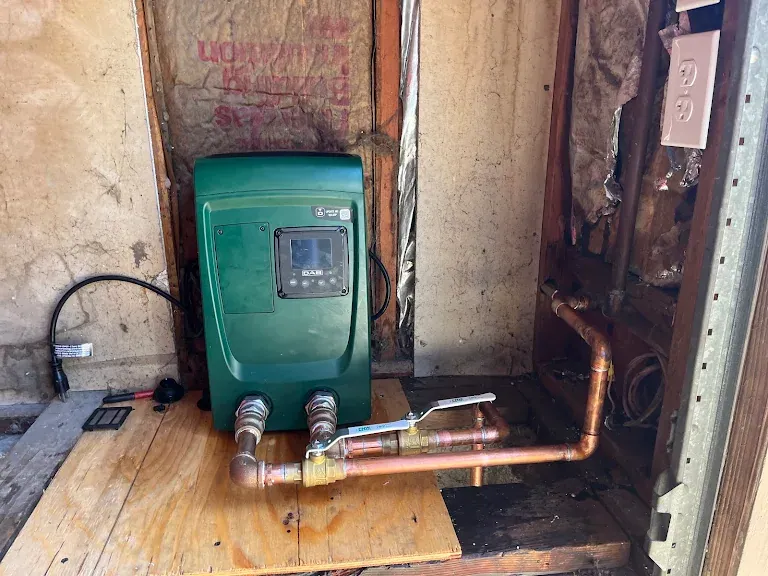
- Service well pressure tanks and switches, and recommend a DAB booster pump for homes on hills or long lines where supply pressure is simply too low
Around Kitsap, Pierce and Mason counties
Pressure around the West Sound varies enormously by district and elevation. Some West Sound Utility District and Silverdale Water zones run high enough that nearly every house has a PRV, and those valves are failing in batches now that the 1990s and 2000s tract homes are reaching twenty-five years. Up the hills in Manchester, Southworth and parts of Gig Harbor, street pressure is low to begin with and a booster is the right tool. Near the shipyard, the galvanized supply lines in 1950s houses have simply closed up with rust, and no valve change will bring them back.
Questions people ask
What is normal household water pressure?
Between 45 and 65 psi at a hose bib with nothing running. Code calls for a reducing valve when street pressure exceeds 80 psi.
What is the difference between low pressure and low flow?
Pressure is the push with everything off; flow is how much water actually arrives when a tap is open. A corroded pipe can show good pressure and terrible flow. The gauge test separates the two.
Can I adjust my pressure reducing valve myself?
There is an adjustment screw on top, and turning it clockwise raises pressure. If adjusting it does nothing, or pressure creeps back down, the valve has failed internally and needs to be replaced.
Is a booster pump a good fix?
When the supply pressure is low and the plumbing is sound, yes. A booster on a corroded galvanized system just pushes harder against a pipe that is closing up, so we check the piping first.
Could the problem be the water heater?
Only if the low pressure is on the hot side alone. Low pressure on both hot and cold at every fixture is upstream of the heater.