Short answer
A booster pump raises the pressure of water that arrives at the house too weak, whether from a utility main at the bottom of a hill, a long service line from a meter at the road, or a well that cannot keep up on its own. It is the right fix only after the cheaper causes are ruled out: a failing pressure reducing valve, a half-closed main valve, a clogged filter, or corroded galvanized pipe. When the supply itself is the limit, a properly sized constant-pressure booster with its own small tank delivers steady pressure to every fixture, and it is a common install on the waterfront bluffs and hillside lots around Puget Sound.
In this guide
Key takeaways
- Low pressure has many cheaper causes than a weak supply; check the PRV, main valve, filters and pipe material before buying a pump.
- Elevation costs pressure: roughly 0.43 psi per foot of rise, so a house 100 feet above the main loses over 40 psi before the water arrives.
- A constant-pressure booster senses demand and varies its speed to hold a set pressure, with a small tank to prevent short cycling.
- Boosters need a backflow preventer and must not pull suction on a utility main; the installation follows the utility's rules.
- Sizing is based on measured incoming pressure and the home's peak flow, not on a catalog guess.
- On a well, the fix may be the pressure switch, tank, or pump before a separate booster is needed.
Why pressure is low on so many local lots
Water pressure is a function of height and friction. A utility main at street level may deliver 60 psi at the meter, but a house perched 80 feet up a bluff above Sinclair Inlet or Colvos Passage has lost about 35 psi by the time water climbs to the second-floor shower. The physics is fixed: every foot of rise costs about 0.43 psi. Hillside lots in Manchester, Southworth, Gig Harbor, Fox Island and all along Hood Canal start with that handicap.
Friction is the other half. A long service line from a meter at the county road to a house set back a quarter mile down a gravel driveway loses pressure to pipe friction every foot of the way, and more if the line is undersized or an old galvanized pipe. Rural Mason County and the big lots in Olalla and Burley see this version. Add a few fixtures running at once and the pressure at the far end collapses.
Some utilities also simply deliver lower pressure in certain zones, particularly at the high points of their systems. If your neighbors at the same elevation have the same complaint, the supply is the limit, and a booster is the tool.
Rule out the cheaper causes first
A booster pump is an unnecessary expense when the real problem is a part that costs a fraction as much. We check all of these before we quote a pump, and you can check several yourself.
- Pressure reducing valve: a PRV that has failed or drifted can hold the whole house at 30 psi while the street is at 70. A gauge on a hose bib before and after tells the story.
- Main shutoff valve: an old gate valve that is only partly open, or a ball valve someone left at 45 degrees, restricts everything downstream.
- Filters: a loaded sediment or carbon cartridge is the most common cause of a gradual pressure loss on a well or filtered house.
- Galvanized pipe: corroded steel lines with pencil-sized openings strangle pressure inside the house; a booster just pushes harder on a blocked pipe.
- Water heater: low pressure only on the hot side points at the heater's inlet, a failing dip tube, or sediment, not the supply.
- Fixture-level issues: one weak faucet or shower is an aerator, cartridge or valve problem, not a whole-house one.
- Leaks: a service line leak between the meter and house drops pressure and raises the bill; the meter test finds it.
Measuring what you actually have
We put a gauge on the hose bib closest to where water enters the house and read static pressure with nothing running. Then we open two or three fixtures and read it again. A static reading of 40 psi that falls to 20 under flow is a supply or line problem. A static reading of 65 that falls to 25 is more likely a restriction inside, such as a PRV or old pipe. A static reading under 35 at the entry point means the supply itself is weak and a booster belongs on the list.
For hillside houses we also measure at the meter when we can, because the difference between the meter and the house is pure elevation and line loss, and it tells us how much boost is needed. Most homes are comfortable between 50 and 65 psi; above 80 the code requires a PRV, so a booster is sized to land in that comfortable band, not to blast.
How a constant-pressure booster works
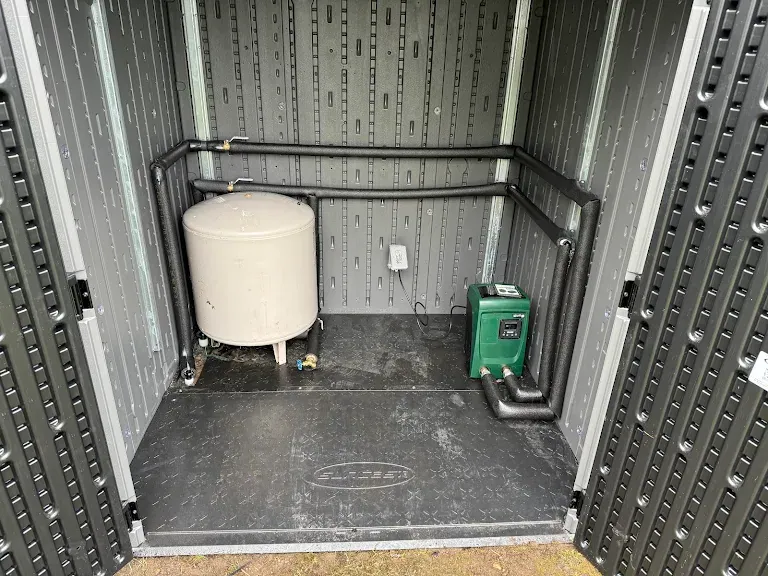
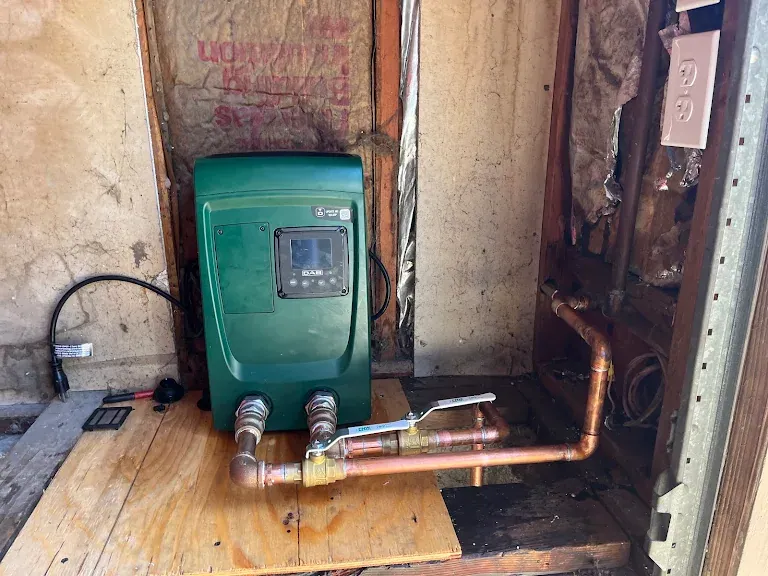
The booster pumps we install, DAB units most often, are compact packages with a multistage pump, a variable-speed controller, a pressure sensor, and a small built-in or adjacent tank. When a faucet opens, the sensor sees pressure drop and the controller spins the pump up just enough to hold the set point, say 60 psi. Open three more fixtures and the pump speeds up; close them and it slows down and stops. The pressure at the tap stays steady no matter how many showers are running.
The small tank gives the system a cushion so the pump is not starting for every glass of water, and it absorbs the pressure spikes that a plain on-off pump would create. Older booster installs used a single-speed pump with a big pressure tank and a switch, which works but delivers the same sawtooth pressure as a well pressure tank. Variable-speed units are quieter, gentler on the plumbing, and use less electricity because they only work as hard as the demand requires.
Dry-run protection is built in, so if the supply fails the pump shuts itself down rather than burning up. A good unit also has a low-inlet-pressure cutoff, which matters on a utility connection for reasons covered below.
Boosting on a utility connection: the rules
A pump on a municipal supply must never create suction on the utility's main, because that can pull contamination into the public system. Washington plumbing code and the local utilities require a backflow preventer ahead of the booster and a low-pressure cutoff that stops the pump if inlet pressure drops too far. Some utilities also want to approve the installation or require a specific assembly. We follow whichever rules apply to your water provider, and we handle the permit.
A pressure tank or an atmospheric break tank is sometimes required between the meter and the pump where the supply is very weak, so the pump draws from stored water rather than directly from the main. That takes more space and we design around it. In most Kitsap and Pierce County homes with a reasonable supply, a backflow assembly, the booster package, and the proper check valves satisfy the code and the utility.
Boosting on a well
On a private well, the pressure problem often lives in the existing system rather than needing a new pump. A pressure switch set to 30/50 can be raised to 40/60 if the pump can deliver it, and a waterlogged tank or clogged filter is fixed for far less than a booster. A constant-pressure controller on the existing submersible pump turns the well itself into a variable-speed system; that is a well pump company's install, and we will say so if it is the better upgrade for your house.
A separate booster makes sense on a well when the house sits well above the pressure tank, when the tank is in a well house a long way from the home, or when a cabin and a shop share a system and the far building starves. In those cases the booster goes at the building that needs it, drawing from the pressure tank's output rather than from a main, and no backflow assembly against a public system is involved.
What the installation looks like
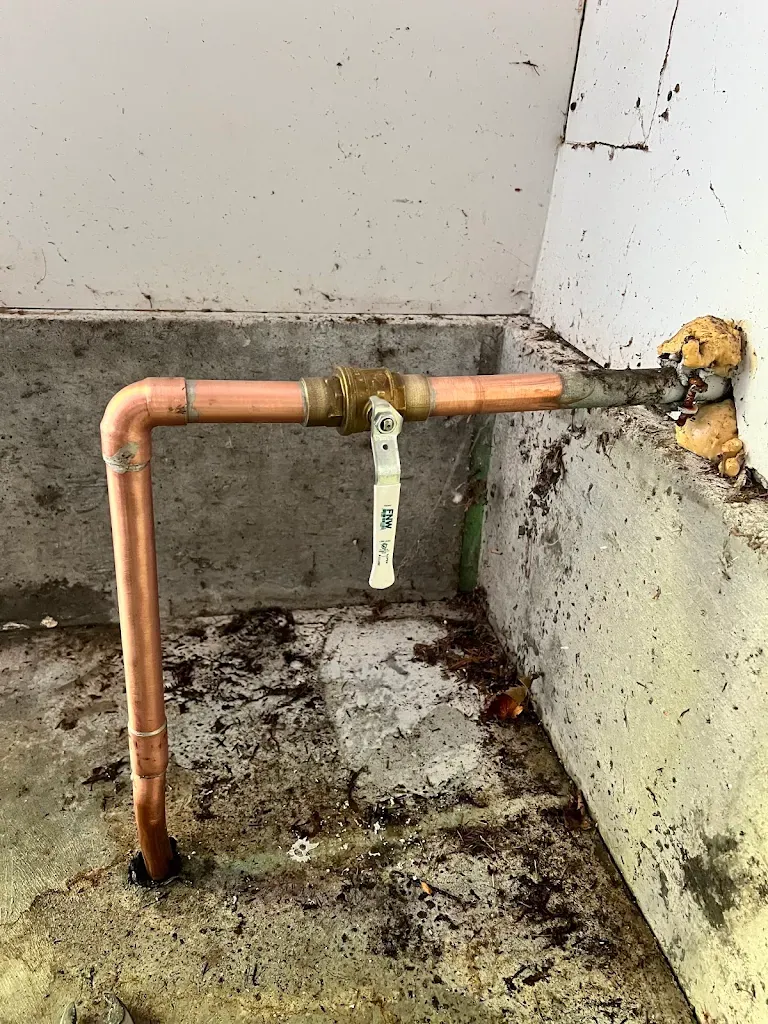
A typical booster install goes near the point where water enters the house: a garage wall, a crawlspace entry, or a utility room. We set the unit on a bracket or pad, plumb it with isolation valves and unions so it can be serviced, install the backflow assembly where the utility requires it, and provide a dedicated electrical circuit, often through an electrician for the wiring. The controller is set to the target pressure and the system is run through several demand scenarios while we watch the gauge.
Noise is modest, like a dishwasher, and a garage or crawlspace location keeps it out of earshot. The pump needs protection from freezing, which matters in an unheated well house in Mason County; we insulate or relocate as needed. Then we show you where the shutoffs are and what the controller's lights mean, and the house finally gets the shower it was built for.
Frequently asked
How much pressure will a booster pump add?
It depends on the unit and the inlet pressure. Residential boosters are sized to bring a weak supply up to the comfortable 50 to 65 psi range at the house, not to maximize pressure. Above 80 psi the code requires a pressure reducing valve, so there is no point in going higher.
Can I install a booster on city water in Kitsap or Pierce County?
Yes, with a backflow preventer ahead of it and a low-pressure cutoff so it can never pull suction on the main. The utility may have additional requirements; we check with yours and pull the permit.
Will a booster fix low pressure in my old galvanized-pipe house?
No. Corroded galvanized pipe restricts flow inside the house, and a booster just pushes harder against the blockage. The right fix there is a repipe, after which the pressure is usually fine without any pump.
Is a booster pump loud?
A variable-speed booster is about as loud as a dishwasher when running and silent when idle. In a garage or crawlspace most people never hear it.
My pressure is fine until someone else turns on a tap. Is that a booster problem?
Often, yes. Pressure that holds at one fixture but collapses under multiple demands points to a weak supply or a long, undersized service line, both of which a booster addresses. We confirm by measuring pressure under flow before recommending one.
Can you improve pressure on my well without adding a booster?
Frequently. Raising the pressure switch to 40/60, replacing a waterlogged tank or clearing filters solves most well-pressure complaints, and all of that is work we do at the well house. A separate booster is for houses sitting well above or far from the tank.
About the author. Gregory Lowe is the owner and lead plumber at Washington Plumbing & Drain, a veteran-owned company in Port Orchard serving Kitsap, Pierce and Mason counties. The guidance here comes from daily work in local homes, not from a content farm. Call (360) 812-1124 with questions.