What it usually looks like
- A puddle on the floor under or beside the water heater that comes back after you dry it
- Rust streaks or mineral crust running down the side of the tank
- Water dripping from the pipe that runs off the relief valve on the side of the tank
- Dampness at the top of the tank around the hot and cold pipe connections
- A hissing or sizzling sound from a gas heater as drips hit the burner area
- The drain pan at the base has standing water in it
Likely causes, most common first
The tank has rusted through from the inside
Every glass-lined steel tank has a sacrificial anode rod that corrodes so the steel does not. Once the rod is used up, usually somewhere past the eight to twelve year mark, the water goes to work on the tank wall. The leak starts as a slow weep at a seam near the bottom and only gets worse. There is no patch for this; the tank is finished.
The temperature and pressure relief valve is discharging
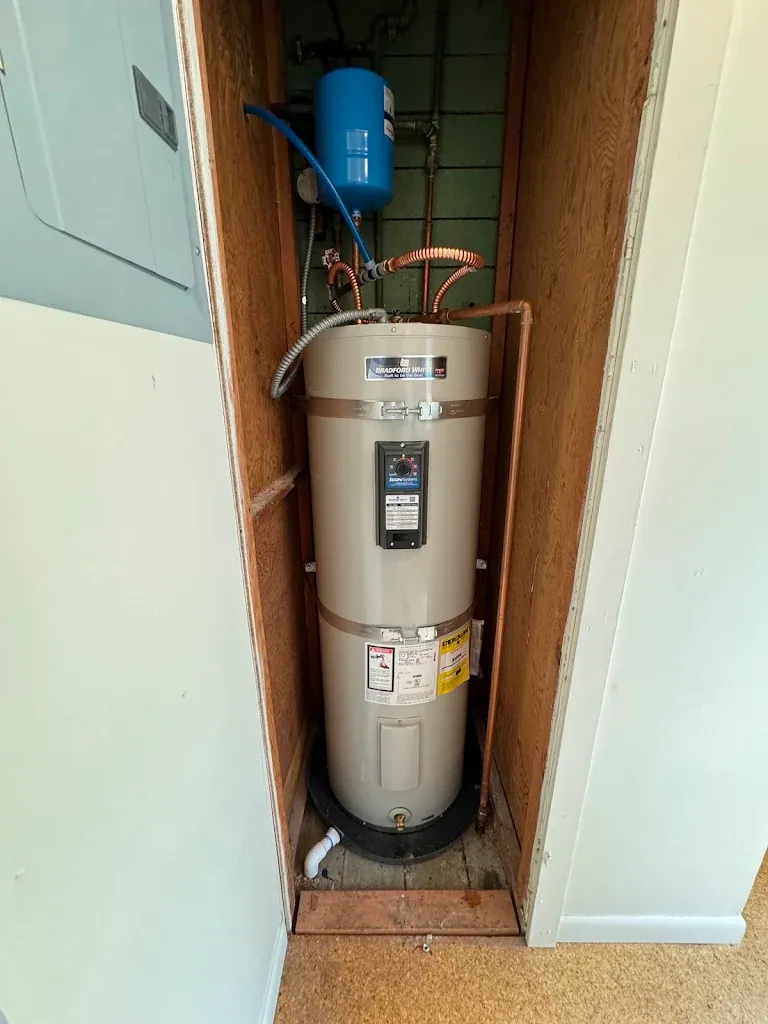
The T&P valve on the side of the tank opens when pressure or temperature climbs past its limit. In homes with a check valve or pressure reducing valve at the meter, heated water has nowhere to expand, so the valve weeps every time the tank fires. That is a thermal expansion problem, not a bad tank, and an expansion tank fixes it. A valve that drips constantly can also simply be worn out.
A loose or corroded connection at the top
The hot and cold nipples, the dielectric unions, and the flex connectors above the tank are the most common sources of a small leak. Water runs down the outside of the tank and pools at the bottom, which fools people into thinking the tank itself failed. Dry it, then look up.
The drain valve at the bottom is not sealing
Cheap plastic drain valves get brittle and the washer inside hardens. If the leak is a steady drip from the spigot-looking valve near the floor, it is often a modest repair rather than a replacement.
Condensation on a gas heater
A gas tank that just refilled with cold well water will sweat as flue gases hit the cold steel, and the drips land in the burner compartment. If the water appears only right after a big draw and stops once the tank is hot, it is condensation and not a leak.
A cracked element gasket on an electric heater
Electric tanks have two heating elements threaded through the side of the tank behind the access panels. The gasket around an element can fail and let water out behind the insulation, which then shows up at the bottom seam.
Safe things to check yourself first
- Dry everything with a towel, then lay paper towels on top of the tank, around each fitting, and on the floor to find exactly where the water first appears
- Look at the end of the relief valve discharge pipe; if it is wet or dripping, that valve is the source
- Check the drain valve near the floor for a drip and make sure its cap or hose connection is snug
- On a gas heater, note whether the water shows up only after a shower and then goes away; that points to condensation
- Find the cold water shutoff on the pipe above the heater and confirm it turns, so you can stop the flow if the leak gets worse
Stop and call if
- Water is coming from the tank body itself, not a fitting, and the flow is more than a weep
- The relief valve is blowing hot water or steam, not just dripping
- You smell gas near the heater
- The leak is soaking drywall, subfloor or a finished ceiling below
- The shutoff valve above the heater will not close
How we diagnose and fix it
- Trace the leak to its true origin with the tank dry and the heater running, rather than guessing from the puddle
- Test static water pressure at a hose bib and check for a closed system that would cause the relief valve to discharge
- Replace failed fittings, the relief valve or the drain valve on the spot when the tank itself is sound
- Install a thermal expansion tank and, if needed, a pressure reducing valve when expansion is the real cause
- When the tank has rusted through, give you a written flat-rate quote for a Bradford White or A. O. Smith replacement, or a Rinnai tankless if that fits the house, and let you decide
- Haul the old heater away and leave the space cleaned up
Around Kitsap, Pierce and Mason counties
A surprising number of leaking-heater calls around Port Orchard, Gig Harbor and Silverdale turn out to be a dripping relief valve caused by a closed plumbing system. Several local water districts run high street pressure and most newer meters have a check valve, which traps expansion inside the house. Older homes near the shipyard add another twist: the heater sits in a damp garage or crawlspace where the exterior of the tank rusts from the outside in, and the bottom seam gives out earlier than the age of the heater would suggest.
Questions people ask
Can a leaking water heater be repaired?
If the leak is at a fitting, the relief valve, the drain valve or an electric element gasket, yes. If the steel tank is leaking through its wall or a seam, no. We tell you which one it is before quoting anything.
Should I turn off the water heater if it is leaking?
If water is actively running, close the cold shutoff above the heater and shut off the gas valve or the breaker. A slow weep can wait for a service call with the heater left on, but put a pan or towels under it and keep an eye on it.
How long will a leaking tank last before it fails completely?
Unpredictable. Some weep for months; others go from a damp spot to a split seam in a week. A tank that is leaking from its body is already past the point where waiting saves money, and a full-tank failure in a finished space does real damage.
Why does the leak only happen in the morning?
That pattern is thermal expansion. The tank reheats overnight after evening showers, pressure climbs, and the relief valve weeps a cup or two. An expansion tank sized to your heater usually ends it.
Will my homeowner's insurance cover a water heater leak?
Sudden damage from a failed heater is often covered; the heater itself usually is not. We photograph the failure and write up what we found, because customers have used that documentation for claims.