
What it usually looks like
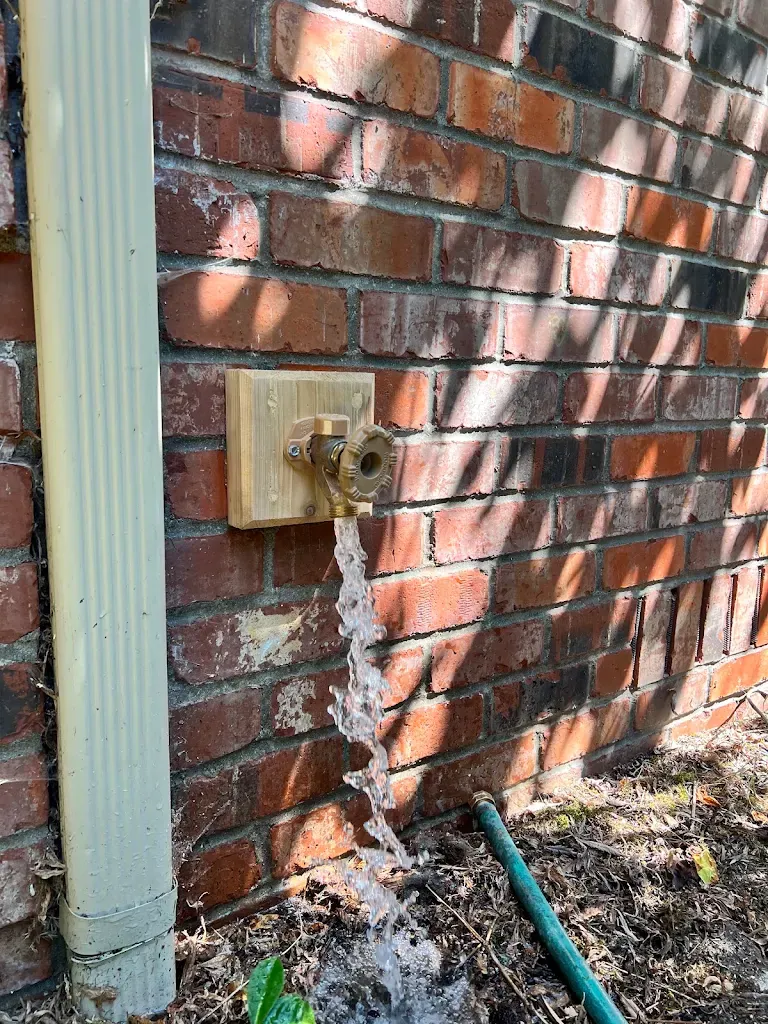
- The spigot drips after it is turned off tight
- Water sprays from behind the handle whenever the faucet is on
- The handle turns but little or no water comes out in cold weather
- You turned the faucet on in spring and heard water running inside the wall or crawlspace
- A wet patch, bubbling paint or stain on the interior wall or ceiling near the faucet
- The vacuum breaker cap on top of the bib spits water or has popped off
Likely causes, most common first
Frost-free bib froze with a hose attached
A frost-free hose bib has a long stem that closes the valve a foot or more inside the heated wall, and the barrel is supposed to drain out the spout when you shut it. A hose, a Y-splitter or a timer left on the spout holds water in the barrel. It freezes, the barrel splits behind the siding, and nothing shows until the valve is opened in spring. After the December 2022 freeze we replaced dozens of these.
Worn washer or seat
Standard compression bibs and frost-free bibs both close with a rubber washer against a brass seat. The washer hardens and cracks after years of being cranked shut, and grit from the hose end scores the seat. The result is a drip from the spout that gets worse the harder you tighten it.
Failed packing around the stem
A graphite or rubber packing under the handle nut seals the stem. When it dries out, water sprays from the handle whenever the valve is open. Tightening the packing nut a quarter turn often stops it; replacing the packing fixes it.
Vacuum breaker failure
Modern bibs carry a small anti-siphon device on top. Its diaphragm wears, and it will spit or drip from the cap, especially when a hose is pressurized and then shut at the nozzle. The cap is sometimes replaceable; often the whole bib is simpler.
Non-frost-free bib on an exterior wall
Older homes near the shipyard and in Tacoma often have a plain sillcock that closes right at the outside wall. Those freeze easily, and the only protection is an interior shutoff and a drain-down every fall, or a foam cover that helps some.
Safe things to check yourself first
- Remove every hose, splitter and timer from every outdoor faucet before the first freeze, and leave them off until spring.
- If the faucet drips from the spout, shut the interior shutoff if there is one, take the handle and bonnet off, and replace the washer and screw. Bring the old parts to the hardware store.
- If it sprays from the handle, snug the packing nut a quarter turn with the water on and see if it stops.
- Before the first use in spring, have someone watch inside the wall or crawlspace while you open the valve slowly. Shut it instantly if you hear water where it should not be.
- Check whether the bib is frost-free by looking at the stem length: a frost-free unit has a long body that goes well into the wall.
- Find and label the interior shutoff for each hose bib if your house has them, and close them in November.
Stop and call if
- Water is running inside the wall, crawlspace or ceiling when the faucet is on
- The faucet body is cracked, bulged or sheared off at the wall
- You cannot shut the faucet off and there is no interior shutoff or main you can close
- A leak behind the siding is causing rot, mold or a sagging floor
- The leak is on the supply side before any shutoff and the water meter is running
How we diagnose and fix it
- Confirm where the leak is by pressurizing the bib with the interior wall or crawlspace observed, and shut the water at the nearest point to stop damage.
- Replace a split or worn bib with a quality frost-free, anti-siphon hose bib, pitched to drain, sealed to the siding, and secured so it does not spin in the wall when a hose is tightened.
- Add an interior ball valve shutoff on the hose bib line where there was none, so you can isolate it every fall.
- Rebuild washers, seats and packing on bibs that are otherwise sound and that match the house, rather than replacing for the sake of it.
- Install yard hydrants for long driveways, gardens and shops where a frost-free hydrant with a buried drain is the right tool.
- Photograph the damage behind the wall and write it up for your insurance file if a burst bib flooded part of the house.
Around Kitsap, Pierce and Mason counties
Hose bibs are the single most common casualty of the rare hard freezes that hit the Puget Sound side. Most winters never drop low enough to matter, so people leave hoses connected year round, and then a week in the teens like January 2024 splits thousands of them from Poulsbo to Puyallup. Waterfront homes on Sinclair Inlet and Hood Canal take the wind off the water straight onto the north-facing bib. Rural properties in Mason County and the Key Peninsula with long driveways and livestock lean on yard hydrants, which have their own set of winter habits.
Questions people ask
How do I know if my outdoor faucet froze and split?
Often you do not until spring. A bib that shows no water at the spout but a sound of running water inside the wall when opened has split. A bib that works but weeps around the stem may have frozen without splitting. When in doubt, open it slowly with someone watching the inside.
Do foam faucet covers work?
They help a plain sillcock through a mild freeze and they do no harm on a frost-free bib. They will not save a frost-free bib with a hose attached, because the problem is inside the wall where the cover cannot reach.
Should I leave outdoor faucets dripping in a freeze?
Not frost-free ones; dripping keeps water in the barrel. For an old-style sillcock with an interior shutoff, close the shutoff and open the outside faucet to drain it instead.
Can you replace a hose bib without opening the wall?
Usually. Most frost-free bibs are reachable from the crawlspace, basement or garage, and some can be swapped from outside if the connection is threaded. Finished walls with a soldered bib may need a small access opening, which we tell you about before starting.
Why does my new frost-free faucet still freeze?
Either a hose was left on it, it was installed without the right pitch, or it is too short for the wall thickness so the valve seat sits in the cold zone. We check all three when we replace one.