
Short answer
Repair a water heater when the failed part is a component (thermostat, element, thermocouple, gas valve, relief valve, anode) and the tank is under about eight to ten years old with no rust or leaks. Replace it when the tank itself is leaking, when it is past ten or twelve years and needs any significant repair, or when a repair would cost a large share of a new unit. Tankless heaters shift the math because the heat exchanger is serviceable and the units last longer, so repair stays reasonable further into their life.
In this guide
Key takeaways
- A leaking tank cannot be repaired. Water from the tank body or the base means replacement, period.
- Check the manufacture date on the data plate before deciding anything. Past ten years, most repairs are money spent on a heater that is about to be replaced anyway.
- Elements, thermostats, thermocouples, gas valves, relief valves and anodes are repairable parts. The tank is not.
- On well water and in homes without a softener or filter, tanks fail earlier. Factor water quality into the age threshold.
- A repair that costs more than roughly a third to half of a new heater on a unit past mid-life is usually the wrong call.
- Replacement is the moment to fix the installation: expansion tank, pan, strapping, mixing valve, proper venting.
First question: is the tank leaking
Everything else in this guide depends on the answer. A tank water heater is a steel vessel with a glass lining and a sacrificial anode rod. When the lining cracks and the anode is used up, the steel rusts from the inside until it weeps. Water at the base of the heater, rust streaks down the side, a damp spot that returns after you dry it, or water in the pan with no drip from a fitting above all point to the tank itself. There is no repair for that. A rusted-through tank is replaced.
But not every puddle is the tank. Water can come from the temperature and pressure relief valve, which drips when it is failing or when the system has no expansion tank. It can come from the drain valve at the bottom, which is a cheap plastic part on many heaters. It can come from the cold or hot connections on top and run down the jacket. It can come from condensation on a gas heater that just refilled with cold water. Dry everything, run the heater, and trace the water to where it starts before deciding the tank is done.
A Bradford White or A. O. Smith tank that is leaking from a fitting on top is a repair. The same tank leaking from the seam at the bottom is a replacement.
Second question: how old is it
The serial number on the data plate encodes the manufacture date; the format varies by brand but a quick search for the manufacturer plus serial number format will decode it. Tank water heaters in our area last somewhere between eight and fifteen years. The low end of that range is a tank on hard or iron-heavy well water in Mason County with no filtration and no anode replacement. The high end is a tank on city water that was flushed yearly and got a new anode at year five.
Our working rule: under eight years, repair almost anything except a leaking tank. Eight to ten, repair the cheap parts and think about replacing before a big repair. Over ten, replace unless the repair is minor and the tank is in visibly good condition. Over twelve, replace.
The reason is not that a twelve-year-old heater will certainly fail tomorrow. It is that a significant repair on it buys you a year or two at most, and when the tank does go, it may go on a Sunday in January with water across the garage floor. A planned replacement on a weekday is cheaper, calmer, and lets you choose the heater instead of taking whatever is in stock.
What is repairable on a tank heater
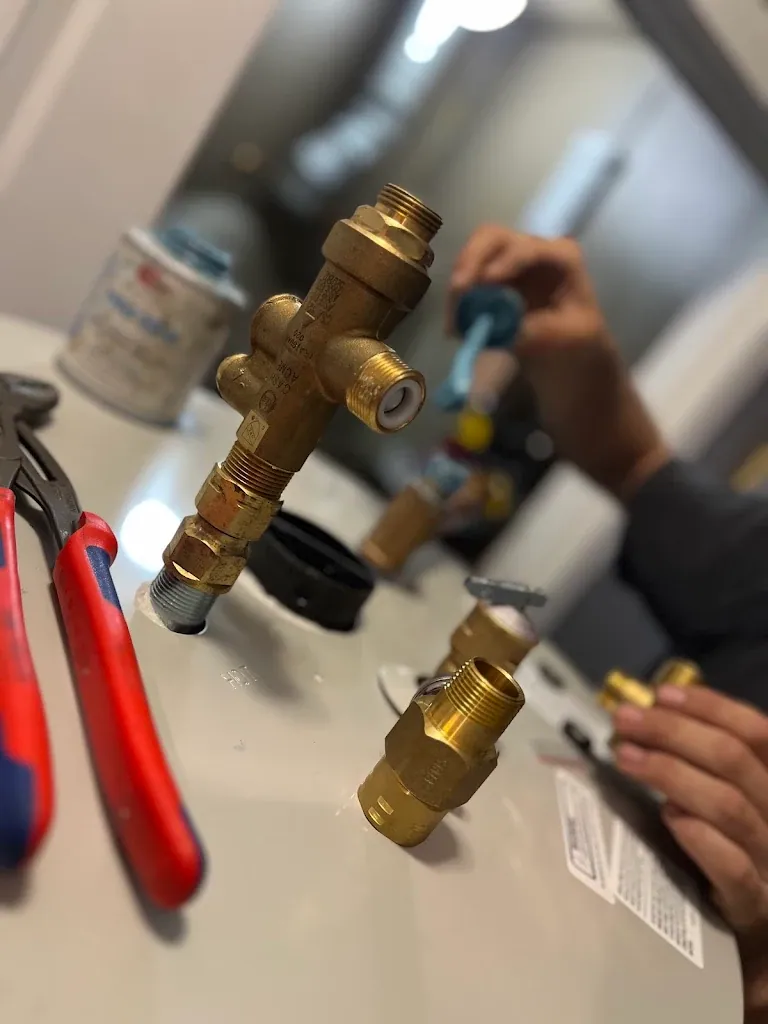
Electric heaters are simple. Two heating elements, two thermostats, a high-limit reset. No hot water at all is often the high-limit button or the upper element. Hot water that runs out fast is usually the lower element. These are inexpensive parts, and replacing them on a heater under ten years old is a sound repair. The elements can also be ruined by sediment burying the lower one, which is a reason to flush the tank at the same time.
Gas heaters have a thermocouple or flame sensor, a pilot assembly, a gas control valve and a burner. A pilot that will not stay lit is usually the thermocouple, a cheap fix. A gas valve that fails is a more expensive part, and on a heater past mid-life it is often the point where replacement makes more sense. Newer gas heaters have sealed combustion chambers and electronic controls that can be diagnosed with the unit's status light.
Both types share the relief valve, the drain valve, the anode rod and the dip tube. The anode is the one most people have never heard of and the one that most affects tank life: it corrodes instead of the tank, and once it is gone the tank starts going. Replacing it every few years can double a tank's life, but it only makes sense on a tank that has not already started rusting.
- Electric elements and thermostats: repair
- High-limit reset: repair, but find out why it tripped
- Thermocouple, pilot assembly: repair
- Gas control valve: repair if the tank is young, otherwise lean toward replacement
- Relief valve, drain valve, dip tube: repair
- Anode rod: replace as maintenance on a sound tank
- Tank body: not repairable
Water quality changes the math around here
Most of Kitsap PUD's and the city systems' water is moderately soft and kind to water heaters. Well water in Mason County, Olalla, the Key Peninsula and parts of South Kitsap often is not. Iron, manganese and hardness build sediment in the bottom of a tank, insulate the lower element or the burner from the water, and chew through the anode rod faster. A tank on untreated well water can be rumbling and popping at five years and leaking at eight.
If you are on a well with no filtration and your heater is failing young, the decision is bigger than repair versus replace. A new heater on the same water will fail on the same schedule. A sediment and iron filter ahead of the heater, or a softener where hardness is the problem, changes the lifespan of the next one. We look at the water when we look at the heater.
Sulfur smell in the hot water only is a related issue: the anode reacting with bacteria in the tank. That is handled with a different anode material or a treatment, not a new heater.
Tankless heaters: a different set of rules
A Rinnai or similar tankless unit does not have a tank to rust through, and its major components, the heat exchanger, the fan, the flow sensor, the igniter and the control board, are all replaceable. Units routinely run twenty years with maintenance. So the age thresholds above do not apply. A twelve-year-old tankless unit with a failed flow sensor is a repair.
What kills tankless heaters early is scale. Hard or mineral-heavy water deposits inside the heat exchanger, flow drops, the unit throws error codes, and eventually the exchanger cracks. Descaling once a year on well water and every year or two on city water prevents it. A tankless heater that has never been descaled and is now throwing codes may or may not be salvageable, and a plumber who knows the units can usually tell after a flush.
Replacement of a tankless unit makes sense when the heat exchanger has failed on an older unit, when parts for a discontinued model are no longer available, or when the unit was undersized for the house in the first place and has been limping along. Replacing a failed tank heater with a tankless unit is a separate decision that depends on gas supply, venting and how the house uses hot water.
Running the numbers without dollar signs
Here is a way to decide that works without a price list. Estimate the heater's remaining life based on age and condition. If the repair would cost less than about a third of a new installation and the heater has more than a few years left, repair. If the repair is more than a third to half the cost of replacement, or the heater is in its last few years, replace. If the heater is leaking from the tank, replace regardless.
Then add the less obvious factors. A repair on a heater that was never installed correctly, with no expansion tank, no pan over a finished space, no strapping, is a repair on a heater you will have to fix anyway. A heater that is too small for the household is a candidate for replacement with the right size even if it still works. An electric heater in a home that now has gas available, or a gas heater in a home considering a heat pump water heater for the efficiency incentives available in Washington, is a conversation worth having before buying a like-for-like replacement.
What we will not do is sell a replacement to someone whose heater needs a thermocouple. Customers have told us that another company recommended a new unit for a problem that was a simple part, and that happens because replacement pays better than repair. Our quote is for what the heater needs.
What a good replacement includes
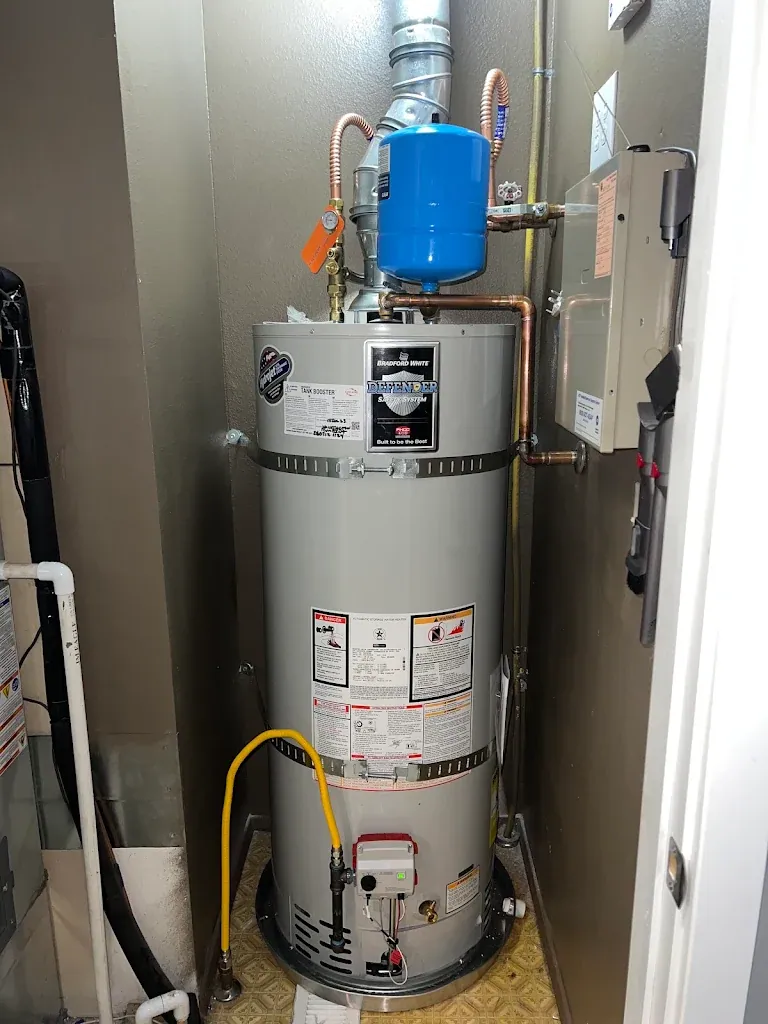
If the decision is to replace, the new installation is the chance to bring the whole setup to current standards. In Washington that means a permit, seismic strapping, a thermal expansion tank on any closed system, a drain pan with a drain line where the heater is above living space, a temperature and pressure relief valve discharge run to a safe location, a new cold-side shutoff, dielectric or brass connections, and correct venting for a gas unit. A thermostatic mixing valve lets the tank run hotter for more usable capacity and better bacteria control while delivering safe water at the tap.
Brand matters less than people think and more than builders admit. We install Bradford White and A. O. Smith tanks and Rinnai tankless units because they hold up on local water and parts are available. Whatever goes in, the install should come with the heater's warranty registered, the permit finaled, and the old unit hauled away.
Frequently asked
My water heater is leaking from the bottom. Can it be fixed?
If the water is coming from the tank body or the base seam, no. If it is coming from the drain valve or the relief valve and running down, yes. Dry the area, run the heater and find where the water starts before deciding.
Is it worth replacing the anode rod?
On a tank under about six or seven years old with no rust, yes, it is the single best thing you can do to extend its life. On an older tank that already shows rust or sediment problems, the money is better saved toward replacement.
How long should a tank water heater last in Kitsap County?
Eight to fifteen years. City water and regular flushing push toward the high end. Untreated well water with iron or hardness pushes toward the low end.
Should I replace a working water heater just because it is old?
If it is past twelve years, especially if it sits above finished space or in a spot where a leak would do real damage, a planned replacement is reasonable. If it is in a garage with a floor drain and still working well, you can wait, but have a plan for when it fails.
My tankless heater is showing an error code. Does that mean replacement?
Usually not. Most codes point to a specific part or to scale in the heat exchanger. A descale and the right replacement part fixes most of them. Tankless units are built to be repaired.
Will you tell me plainly whether I need a new heater?
Yes. The estimate is free, the diagnosis is what you are paying us to be right about, and we have told plenty of customers that the part another company wanted to replace with a whole unit was a small repair.
About the author. Gregory Lowe is the owner and lead plumber at Washington Plumbing & Drain, a veteran-owned company in Port Orchard serving Kitsap, Pierce and Mason counties. The guidance here comes from daily work in local homes, not from a content farm. Call (360) 812-1124 with questions.