
Short answer
A sewer cleanout is a capped pipe, usually three or four inches across, that gives direct access to your main drain line. Outside, look for a white, black or green threaded cap at ground level within a few feet of the foundation on the side of the house facing the sewer main or septic tank; inside, check the crawlspace, the basement floor near the foundation wall, or a wall behind a toilet. Many homes around Port Orchard and Bremerton built before the 1980s have no exterior cleanout at all, which is why we install them so often.
In this guide
Key takeaways
- Cleanouts are capped pipes that let a plumber run a cable, jetter or camera straight into the main line without pulling a toilet or going through the roof.
- Outside cleanouts usually sit near the foundation between the house and the street or septic tank, often buried under bark, sod or a deck.
- A two-way cleanout, with a Y or a pair of caps, lets equipment go both toward the house and toward the sewer or tank.
- During a backup, loosening the exterior cleanout cap can relieve the line outside instead of inside. Stand clear and go slow.
- A home with no cleanout can still be cleared, but it costs more and takes longer every single time. Installing one pays for itself the second time the line clogs.
- On septic, the cleanout is often near where the line leaves the house, and the tank lids are a separate thing.
What a cleanout is and why it matters
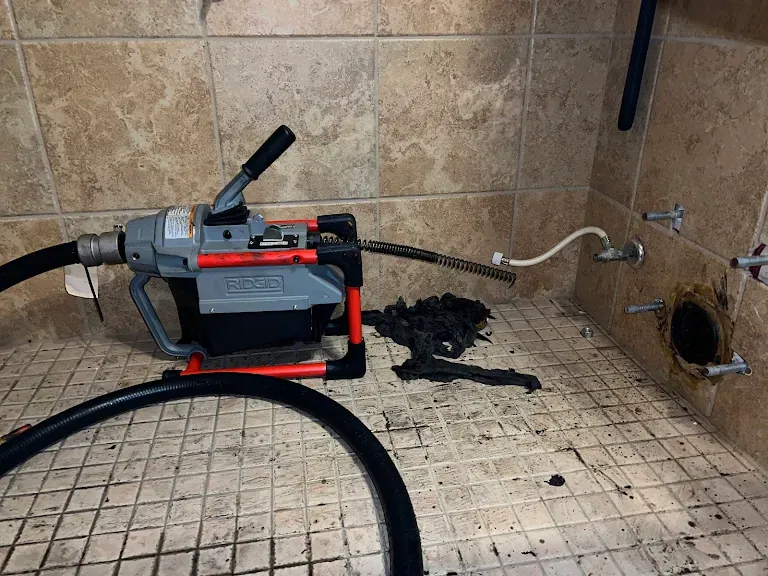
Every drain in your house joins a single main line that leaves the building and runs to either the public sewer or a septic tank. A cleanout is a fitting on that line with a removable cap. Pull the cap and you are looking straight into the pipe. That is where a sectional drain machine, a hydro jetter or a push camera goes in.
Without one, the options are worse. We can pull a toilet, which means a new wax ring and a messy floor. We can run a cable down a roof vent, which means a ladder on a wet roof in November and a cable fighting its way around two bends before it even reaches the main. Both work, but neither is as fast, as clean, or as effective as a straight shot through a cleanout. When the camera goes in, the difference is even bigger; a camera through a toilet flange rarely gets as far as one through a proper cleanout.
What it looks like
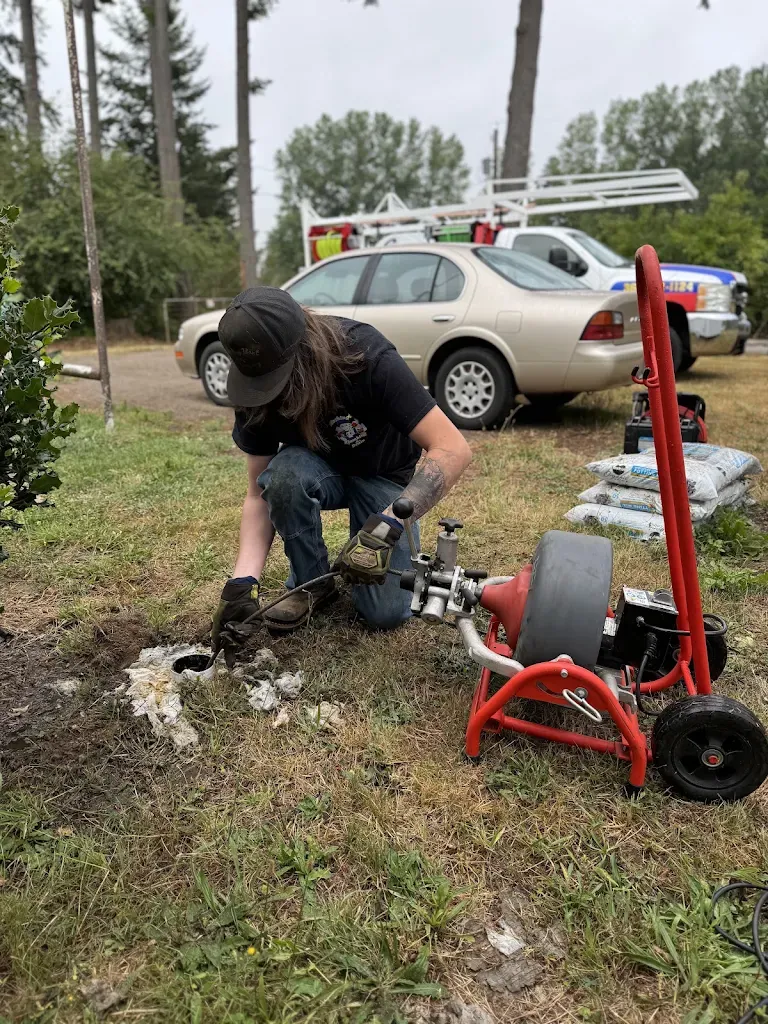
Outside, a cleanout is a round cap, typically three or four inches in diameter, flush with or slightly above the ground. On homes from the last forty years it is usually white PVC or black ABS with a square nut molded into the center of the cap. Some are covered by a green or black plastic lid about the size of a dinner plate, similar to an irrigation valve box. Older installations may be a brass or cast iron cap on a clay or cast iron riser.
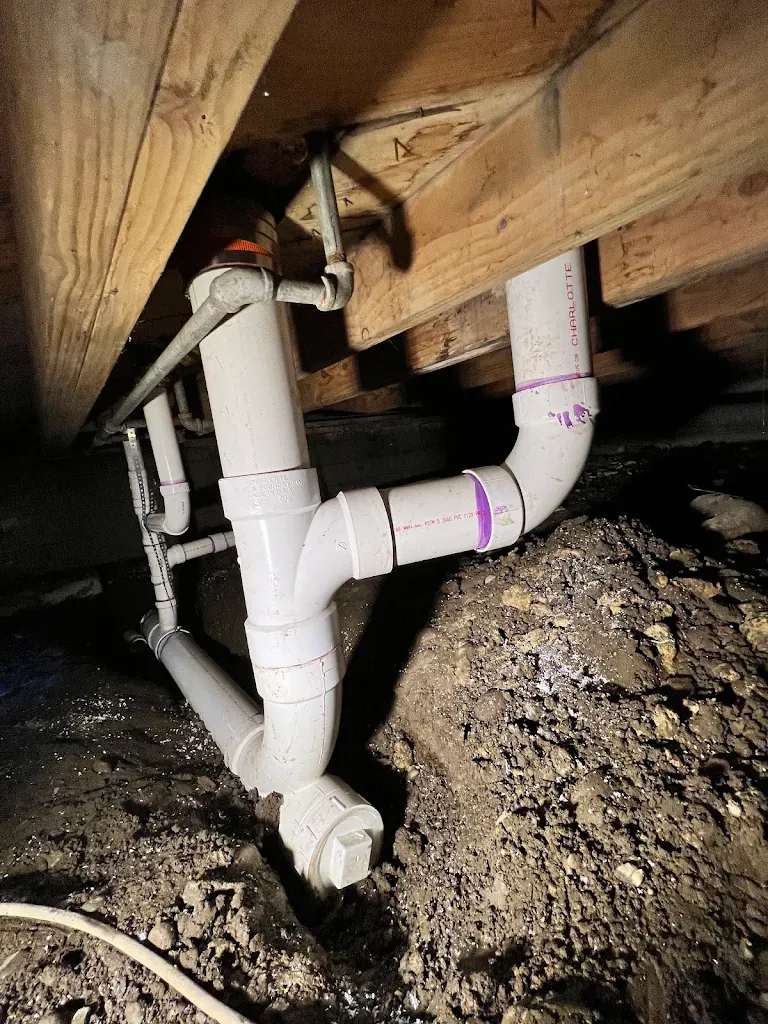
Inside, cleanouts show up as the same style cap on a fitting in the crawlspace, usually where the main line makes its turn to exit the foundation. Basements, which are rare in Kitsap but common in parts of Tacoma, often have a cap in the floor near the foundation wall or a riser coming up out of the slab. You may also find small cleanout caps on walls behind toilets or in the back of a cabinet under a sink; those serve a branch line, not the main, and they help with that one fixture only.
Where to look on your property
Figure out which direction your sewer goes. On sewer, that is toward the street where the main runs, or toward an easement at the back or side of the lot in some older Bremerton and Port Orchard neighborhoods. On septic, it is toward the tank, which is often in the front or side yard with the drainfield beyond it. The cleanout is almost always within a few feet of the foundation on that side, often lined up with a bathroom or the kitchen.
Walk the foundation slowly and look for anything round. Bark mulch, decades of sod, a raised flower bed, a deck built over the spot, or a gravel driveway that was widened can all bury a cleanout. We find a lot of them under the edge of a deck in Gig Harbor and Silverdale homes where the deck went in after the house. A long screwdriver pushed into bark along the foundation will hit a cap with a distinct click.
If the yard turns up nothing, check the crawlspace near the exit point of the main line, and look at the roof for the largest vent pipe, which usually sits above the main bathroom. The main line typically leaves the house roughly below that vent.
Why so many local homes do not have one
Plumbing codes have required accessible cleanouts for a long time, but the specifics on exterior cleanouts near the building have changed over the decades, and enforcement on remodels was loose. A lot of the housing stock near PSNS and along Sinclair Inlet went up fast in the 1940s through 1970s for shipyard families, and plenty of those homes have a main drain that goes from the crawlspace straight into the ground with no access at all. Cabins in Mason County and older waterfront places on Hood Canal and Fox Island are the same story, sometimes worse.
Add to that the homes where a cleanout existed but was paved over, buried under a slab for an addition, or cut off when a septic system was converted to sewer along Beach Drive or in Manchester. The pipe is there. The access is gone.
When we camera one of these lines and find a problem, we recommend adding a cleanout at the same time as any repair. Once the ground is open, putting a two-way cleanout on the line is a small addition to the job, and it changes every future service call from a project into a quick visit.
Using the cleanout during a backup
If sewage is coming up in a tub or floor drain and you have an exterior cleanout, you can give the line somewhere else to go. Put on gloves, kneel to the side rather than directly over the cap, and loosen it slowly with a wrench on the square nut. If the line is full, you will hear it and see water seeping at the threads. Let it ease out before you take the cap off completely. The line relieves into the yard, which is ugly but a lot better than into the hallway.
Do not do this with an interior cleanout in a crawlspace or basement unless you want sewage there instead. And do not put chemicals down a cleanout; whoever opens the line next, probably us, ends up wearing them.
After the backup is cleared and the cap is back on, snug it by hand plus a quarter turn with the wrench. Overtightened caps crack, and a cap that is cracked lets rainwater and roots into the line.
Cleanouts on septic systems
Septic homes have a few more pieces. The house cleanout sits near the foundation as described. The septic tank has one or two lids, often green plastic risers or buried concrete lids, and those are for pumping and inspection, not for drain cleaning. Beyond the tank there may be a distribution box and a pump chamber with its own lid and an alarm box on the house.
A slow drain on a septic system can be a clogged house line, a full tank, a failed effluent pump, or a saturated drainfield in the wet months, and each one is a different call. We handle the house line, the cleanout and the pump chamber. Tank pumping and drainfield work belong to a septic company. When you call, tell Corinne when the tank was last pumped; it saves everyone a wasted trip.
How we add a cleanout
We locate the main line with the camera and a locator, then dig down to it just outside the foundation. On most properties around here that is two to four feet of glacial till, sometimes with a layer of clay that holds water in winter, so the hole stays open and the work goes quickly. We cut in a two-way cleanout fitting, bring a riser up to grade, cap it, and backfill. On a sewer line repair, the cleanout goes in at the point of repair and sometimes at the property line as well.
A two-way fitting is worth asking for. It lets equipment run toward the street or the tank to clear a clog, and back toward the house to clear the line under the slab or crawlspace. We always leave the cap visible, and we will show you where it is before we pull out of the driveway.
- Keep bark and sod from burying it; a marker stake or a paver around it helps
- Do not build a deck, shed or patio over it without a hatch
- Check that the cap is snug after any landscaping work
- Photograph its location and keep the picture with your house documents
Frequently asked
Is a cleanout required by code in Washington?
Current plumbing code requires accessible cleanouts on building drains at specific points, and inspectors in Kitsap, Pierce and Mason counties look for them on new work and sewer repairs. Older homes were built under older rules and many have none. Nobody will make you add one to an existing home, but your drain cleaning bills will.
Can you clear my main line if there is no cleanout?
Yes. We go through a roof vent or pull a toilet and run the machine from the flange. It takes longer and costs more than a cleanout job, and it is harder to run the camera that way. If the line clogs a second time, adding a cleanout is usually the better spend.
How deep is the sewer cleanout?
The cap should be at or just above ground level. The pipe it connects to is usually two to four feet down near the foundation and deeper as it heads toward the street. If you find a cap a foot under the mulch, it was installed at grade and the landscaping grew around it.
What is a two-way cleanout?
A fitting shaped so a cable can be run in either direction, toward the sewer or back toward the house. It usually has two caps side by side or a single wye with a straight run. We install two-way cleanouts on repairs whenever there is room.
There is a cap on the wall behind my toilet. Is that my sewer cleanout?
Probably a branch cleanout for that bathroom group. It helps with a clog in that bathroom but it is not the main line access. Many homes have both; some have only the branch caps.
My cleanout cap is cracked. Does that matter?
Yes. Rainwater, roots and dirt get in, and sewer gas gets out. Caps are inexpensive to replace. Note the pipe material and diameter, or send us a photo and we will bring the right one next time we are out.
About the author. Gregory Lowe is the owner and lead plumber at Washington Plumbing & Drain, a veteran-owned company in Port Orchard serving Kitsap, Pierce and Mason counties. The guidance here comes from daily work in local homes, not from a content farm. Call (360) 812-1124 with questions.